
How Much Does It Cost to Build a
1000 Sq Ft House in Chennai?
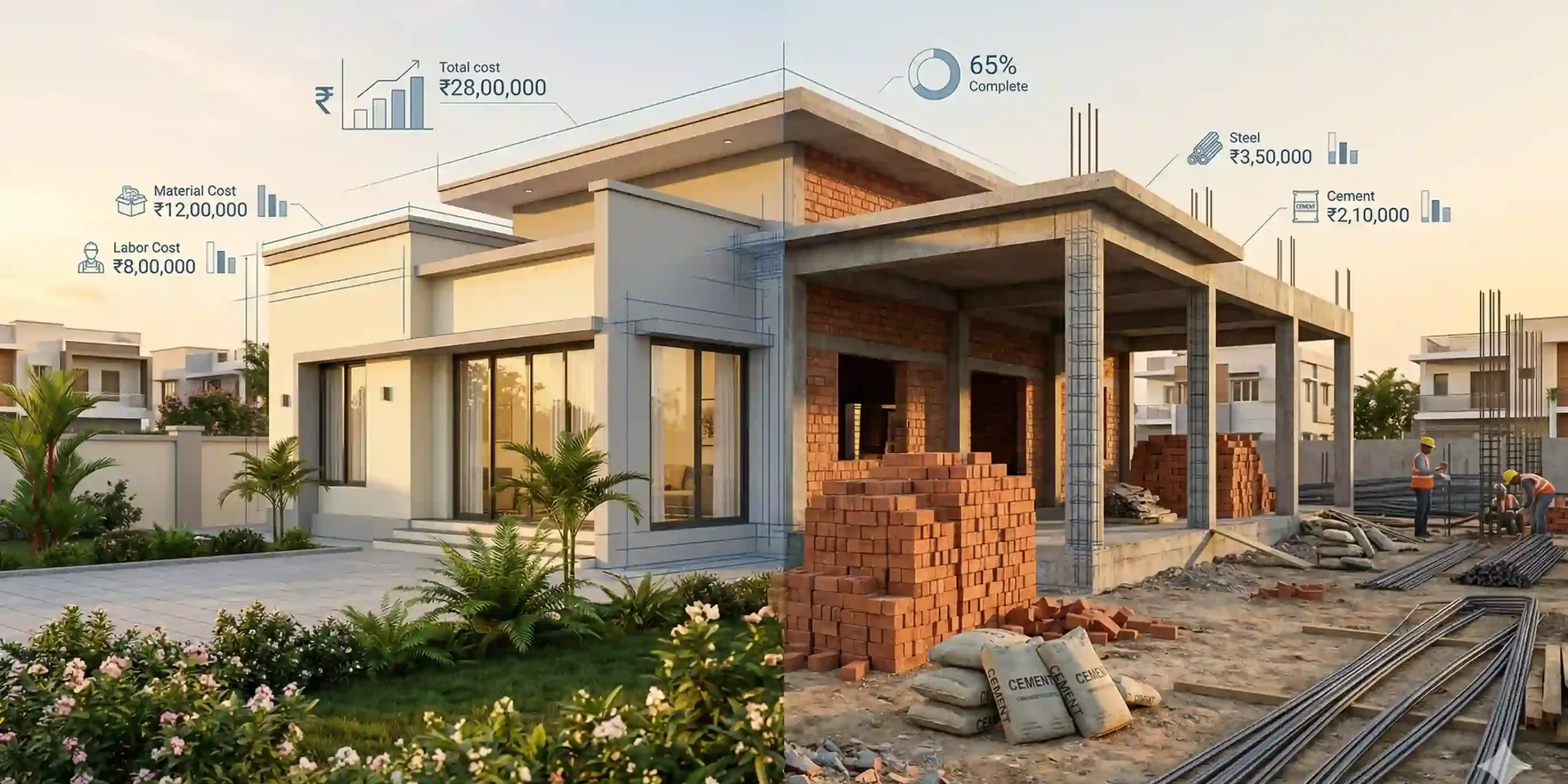
The all-in construction cost for a 1000 sq ft house in Chennai currently ranges from ₹1,800 to ₹4,000 per sq ft. At the basic tier, expect ₹18–22 lakhs. A mid-range finish runs ₹25–32 lakhs. Premium construction with high-end finishes reaches ₹35–40 lakhs. These ranges include civil work and finishing but exclude land cost, CMDA/DTCP approval fees, borewell, and compound wall.
Building a 1000 sq ft house in Chennai in 2025 will cost you between ₹18 lakhs and ₹40 lakhs — depending on your location, material choices, and finish level. That's the honest, Chennai-specific number, not a national average recycled from a blog written 500 kilometres away. Having delivered 500+ residential projects across Chennai, from Tambaram to OMR to Anna Nagar, HireandBuild knows exactly where budgets get stretched and where smart homeowners save money.
In this guide, you'll find a complete stage-by-stage cost breakdown, area-wise price variation across 8 Chennai zones, updated 2025/2026 material prices, a month-by-month construction timeline, an 8-question contractor vetting checklist, and your construction loan options. Everything you need before signing anything.
What Is the Construction Cost Per Sq Ft in Chennai Right Now?
Construction cost in Chennai ranges from ₹1,800 per sq ft (basic) to ₹4,000 per sq ft (premium) for an RCC framed structure. These are live 2025/2026 figures, reflecting current TMT steel at ₹68–78/kg and cement at ₹380–460 per bag. Most competitor sites are quoting figures that are 12–24 months out of date — the difference matters when steel alone accounts for 15–18% of your total budget.
Here's how the three tiers stack up for a 1000 sq ft build:
| Grade | Rate (₹/sq ft) | Total for 1000 sq ft | What You Get |
|---|---|---|---|
| Basic | ₹1,800–2,200 | ₹18–22 lakhs | Wire-cut bricks, ceramic tiles, standard plastering, basic fittings |
| Mid-Range | ₹2,500–3,200 | ₹25–32 lakhs | AAC blocks, vitrified tiles, waterproofing treatment, branded fittings |
| Premium | ₹3,500–4,000 | ₹35–40 lakhs | Porotherm blocks, imported tiles, premium electrical, home automation wiring |
What most Chennai homeowners miss: these per-sqft rates cover only the built-up area — not the full out-of-pocket cost of owning the finished home. Government approvals, utility connections, and compound wall come on top. We break those out next.
Full Stage-by-Stage Cost Breakdown — Foundation to Handover
A 1000 sq ft house in Chennai goes through 6 distinct construction phases, each with a predictable cost band. Understanding this breakdown lets you track progress, release payments with confidence, and catch any contractor padding before it becomes a problem.
| Stage | % of Budget | Cost Range (₹) | Key Work |
|---|---|---|---|
| Soil Test + Site Prep | 1–2% | ₹15,000–30,000 | Bore test, levelling, PCC bed |
| Foundation | 15–20% | ₹3–5 lakhs | Isolated footing or pile foundation, plinth beam casting |
| Superstructure | 30–35% | ₹6–8 lakhs | RCC columns, beams, roof slabs |
| Brickwork / Blockwork | 10–12% | ₹2–3 lakhs | AAC blocks or wire-cut bricks, door/window frames |
| Plastering & Waterproofing | 8–10% | ₹1.5–2.5 lakhs | Internal/external plaster, terrace & sunken slab waterproofing |
| Finishing Works | 25–30% | ₹5–8 lakhs | Flooring, doors, electrical (CPVC pipes, Finolex wiring), painting |
The foundation stage is where costs most often surprise Chennai homeowners. Areas like OMR, Sholinganallur, and parts of Pallavaram sit on coastal clay or filled-up land — these typically require pile foundation instead of isolated footing, adding ₹1–1.5 lakhs to your budget. The only way to know for certain is a soil investigation report (₹8,000–15,000) done before design finalisation.
The finishing works stage is the other wildcard. Vitrified tiles cost 2–3x more per sq ft than ceramic. CPVC pipes outperform standard GI but cost 15–20% more. These choices compound across your entire floor area — a ₹20/sq ft upgrade decision means ₹20,000 extra on a 1000 sq ft build.
What's NOT Included in Your Per-Sqft Rate — The Hidden Costs Nobody Tells You
Here's the thing: when a contractor quotes you ₹2,200 per sq ft, that number typically covers only the structural and finishing work inside your four walls. Your actual out-of-pocket spend will be 20–35% higher once you add the following items — all of which are real, unavoidable, and completely absent from most contractor quotes.
| Item | Estimated Cost (₹) | Included in Per-Sqft Quote? |
|---|---|---|
| CMDA / DTCP Plan Approval Fees | ₹50,000–80,000 | ❌ Almost Never |
| Compound Wall (30 ft perimeter) | ₹1.0–1.5 lakhs | ❌ Rarely |
| Underground Sump (5,000 litres) | ₹40,000–60,000 | ❌ Rarely |
| Borewell (300 ft depth) | ₹60,000–90,000 | ❌ Never |
| TNEB Permanent Connection | ₹20,000–40,000 | ❌ Never |
| Architect / Structural Design Fee | ₹30,000–60,000 | ❌ Sometimes |
| Contingency Budget (10–15%) | ₹2.0–4.0 lakhs | ❌ Never Mentioned |
CMDA approval is the single biggest blindspot in Chennai house construction budgets. If your plot falls within the CMDA jurisdiction — which covers Greater Chennai and most suburban zones — you need a sanctioned building plan before any foundation work begins. The process takes 45–90 days and costs ₹50,000–80,000 in government fees, depending on your plot size, setback area, FSI, and floor area ratio (FAR) permitted under Tamil Nadu Building Rules 2019.
The contingency budget deserves special mention. Every experienced builder builds 10–15% into the plan. Design changes mid-construction, material price movements, and unexpected soil conditions all draw from this buffer. If your contractor hasn't mentioned it, ask why.
🔍 Not sure what your real total budget looks like — CMDA, approvals, sump, borewell, everything included? HireandBuild gives you a free, line-by-line cost estimate before any work begins. No commitment. No surprise line items later.
→ Calculate Your Free EstimateArea-Wise Construction Cost Variation in Chennai — 8 Zones
Chennai is not one construction market. It's eight distinct zones with meaningfully different soil conditions, labour availability, material transport costs, and demand pressure. Here's the only area-by-area construction cost breakdown available for Chennai homeowners.
| Area / Zone | Cost per Sq Ft | Key Reason for Variation |
|---|---|---|
| Anna Nagar / Nungambakkam | ₹2,800–4,000 | Premium labour demand, tight plots needing skilled formwork |
| Velachery / Sholinganallur | ₹2,500–3,500 | IT corridor demand; waterlogging risk adds drainage cost |
| OMR / Perungudi / ECR | ₹2,400–3,200 | Coastal clay / fill zones — pile foundation mandatory in many pockets |
| Chromepet / Pallavaram | ₹2,200–2,800 | Moderate costs; good road access reduces material delivery charges |
| Tambaram / Guduvanchery | ₹1,800–2,400 | Most budget-friendly zone; wire-cut brick contractors dominate |
| Ambattur / Avadi | ₹2,000–2,600 | Industrial zone overspill labour; moderate pricing |
| Perambur / Kolathur | ₹2,200–2,800 | Dense urban area; wire-cut brick and AAC block hybrid common |
| Villivakkam / Maduravoyal | ₹2,200–2,800 | Good M-sand availability from nearby depots keeps costs stable |
Picture this: you've just bought a plot in Velachery. Budget is ₹32 lakhs. You've got three contractor quotes, all around ₹2,500/sqft — looks clean. But none of them have mentioned the drainage work your low-lying plot will need (₹60,000–80,000) or the CMDA approval fees (₹60,000+). That's ₹1.2–1.5 lakhs missing from the picture before a single brick is laid. This is the Chennai construction reality that area-specific planning protects you from.
How Soil Type Affects Your Foundation Cost in Chennai
The soil test is the most routinely skipped step in Chennai residential construction — and the one that causes the most mid-build surprises. A soil investigation report costs ₹8,000–15,000. It can save you ₹1–2 lakhs in wrong foundation choices and 4–6 weeks in construction delays.
Red Soil Zones — Tambaram, Chromepet, Avadi
Generally stable, good bearing capacity. Isolated footing works well under IS 456 specifications. Standard foundation budget: ₹3–4 lakhs for a 1000 sq ft single-floor build.
Black Cotton Soil Zones — Parts of Ambattur, Kolathur
Expansive soil — swells when wet, shrinks in summer. Requires deeper footing with reinforced plinth beam to prevent differential settlement. Adds ₹30,000–60,000 to foundation cost over a standard design.
Coastal Fill / Clay Zones — OMR, ECR, Parts of Velachery
This is where pile foundation becomes mandatory. Boring records from CMDA frequently flag these zones. In our projects along OMR, we've recorded soil bearing capacity as low as 10 tonnes/sq metre — well below the 15–20 tonnes needed for isolated footing. Pile foundation adds ₹1–1.5 lakhs over isolated footing on a typical 1000 sq ft footprint.
Under BIS standards IS 456 and IS 432, the foundation type must match the soil bearing capacity documented in the investigation report. Skipping it and hoping for the best is how cracks appear in your walls three years later.
Current Material Prices in Chennai — 2025/2026 Update
Material costs account for 55–65% of your total construction budget. Most competing blogs are showing prices from 2023 or early 2024 — which understate your real cost by ₹2–5 lakhs on a 1000 sq ft build. These are live Chennai market prices as of early 2026.
| Material | Specification | Price (Chennai Market) | Notes |
|---|---|---|---|
| Cement | 50 kg bag | ₹380–460 | Coromandel, UltraTech, Chettinad — Chennai market leaders |
| TMT Bars | Fe 500 grade | ₹68–78/kg | Tata, JSW, Agni brands preferred by structural engineers |
| M-Sand | Per cubic foot | ₹45–55 | River sand banned in Tamil Nadu; M-sand is the standard |
| Wire-Cut Bricks | Per 1,000 units | ₹7,000–9,000 | Manufactured in Perambur / Kolathur belt |
| AAC Blocks | Per cubic metre | ₹3,800–4,500 | 30–40% lighter; better thermal insulation for Chennai heat |
| Vitrified Tiles | Per sq ft | ₹45–130 | Wide range; Italian brands at top end |
| Ceramic Tiles | Per sq ft | ₹18–45 | Budget and mid-range bathrooms |
| CPVC Pipes | Per running ft | ₹28–45 | Preferred over GI for Chennai's hard water quality |
A 1000 sq ft RCC framed structure requires approximately 350–420 bags of cement, 4–5 MT of TMT Fe 500 grade bars, and 7,000–9,000 wire-cut bricks or the AAC block equivalent. At current prices, the steel alone costs ₹2.7–3.9 lakhs — and it's the most price-volatile line item on your BOQ.
One practical move: lock in your steel order when prices are favourable. TMT bar prices in Chennai fluctuate by ₹4–8/kg across quarters. On a 1000 sq ft build, that's a ₹20,000–40,000 swing depending on when you buy.
Month-by-Month Construction Timeline — 1000 Sq Ft in Chennai
Every builder says "8–12 months." Nobody shows you what actually happens each month. This timeline is drawn from real HireandBuild project schedules, accounting for CMDA approval time, Chennai's northeast monsoon, and typical contractor workflows.
The two biggest schedule killers in Chennai: CMDA approval delays (particularly during March and September audit cycles) and the northeast monsoon (October–December), which halts plastering and finishing work. We always advise clients to target foundation completion before October and plan masonry and finishing for the dry season (January–May).
Basic vs Mid-Range vs Premium — What Do You Actually Get?
The grade label isn't just a price tier. Each level reflects real specification choices that affect your daily comfort, maintenance cost, and resale value for the next 20 years.
In our experience, most Chennai homeowners start with mid-range specifications and selectively upgrade two areas: flooring and electrical. These are the two most visible and highest-impact choices on daily quality of life. This hybrid approach gives the best value combination without committing to full-premium cost.
How to Choose a Contractor in Chennai — 8 Questions to Ask Before Signing
Most Chennai homeowners sign a contract after collecting three quotes and going with the lowest bid. That's exactly how cost overruns and substandard materials enter the picture. These 8 questions are what HireandBuild answers for every client — and what you should demand from any contractor before signing.
- Can you give me a detailed BOQ (Bill of Quantities)? A serious contractor provides a line-item document breaking down quantities and unit rates for every material and labour category. A quote that only shows a per-sqft rate with no BOQ is a red flag.
- What specific grade and brand of TMT bars and cement will you use? They should name Fe 500 grade TMT bars (Tata, JSW, or Agni), a cement brand (UltraTech, Chettinad, or Coromandel), and specify IS 456 compliance. Vague answers mean room to substitute cheaper alternatives mid-build.
- Does your quote include CMDA/DTCP approval? Many contractors exclude this. Clarify upfront or the ₹50,000–80,000 approval fee arrives as a surprise invoice after you've already committed.
- What waterproofing system do you use for the terrace and sunken slab? The answer should mention a named system — crystalline treatment, torch-applied membrane, or integral waterproofing compound. 'We do waterproofing' is not an answer.
- What is your payment schedule and milestone triggers? Standard is 10% advance, then stage-based releases tied to foundation, slab, masonry, and handover completion. Anyone requesting 40–50% upfront before work begins is a significant risk.
- Can you give me contact details for two completed projects I can visit? Legitimate contractors say yes immediately. Any hesitation is a serious warning sign.
- Do you handle the TNEB permanent connection and plinth area certificate? These are post-construction requirements most homeowners don't know about. Some contractors complete structural work and disappear — leaving you to handle this alone.
- Is your quote fixed-price or does it vary with material costs? A fixed-price contract with a material specification schedule protects you from steel and cement price spikes. Always prefer it over open-ended cost-plus agreements.
HireandBuild answers all 8 questions with documented proof. Fixed-price contracts. Transparent BOQ. RERA-compliant documentation. Dedicated project manager on every site. 500+ homes delivered across Chennai.
→ Join 500+ Chennai Homeowners — Get Your Free QuoteConstruction Loans for Self-Build in Chennai — What You Need to Know
Construction finance is how most Chennai homeowners bridge the gap between savings and build cost. Here's what the three major lenders offer for self-construction projects on your own plot.
| Lender | Loan Type | LTV Ratio | Interest Rate | Key Notes |
|---|---|---|---|---|
| SBI | Self-Construction Home Loan | Up to 80% | 8.5–9.5% p.a. | Sanctioned plan required; disbursed in construction stages |
| HDFC Bank | Home Construction Loan | Up to 75–80% | 8.75–9.75% p.a. | Plot + construction combined loan option available |
| LIC Housing Finance | Griha Vikas Loan | Up to 75% | 8.65–9.65% p.a. | Strong option for salaried individuals in Chennai |
Banks don't disburse the full loan amount on day one. They release funds in 3–5 tranches tied to construction milestones — typically after foundation, slab, masonry, and final handover. Your contractor's payment schedule must align with your bank's disbursement timeline or you'll face cash flow gaps mid-build.
You'll need a CMDA/DTCP-approved plan, a registered sale deed for the plot, and a licensed civil engineer's cost estimate to apply. Most loan approvals take 3–4 weeks once documents are in order. Starting the loan process during the CMDA approval wait period is the best way to avoid any delay at foundation stage.
How to Avoid Cost Overruns — The 5 Most Common Causes in Chennai
Cost overruns affect an estimated 60% of self-build projects in Chennai. Here's why they happen — and the specific actions that prevent each one. For a broader overview, see our complete house construction tips guide for Chennai homeowners.
1. Not Locking In Specifications Before Signing
If the contract says 'vitrified tiles' without specifying brand, size, and grade, your contractor can use the cheapest option available and stay technically compliant. Always attach a material specification schedule to the contract — naming brand, grade, and finish for every major item.
2. Skipping the Soil Test
Discovering you need pile foundation after excavation has already started adds ₹1–1.5 lakhs and 3–4 weeks of delay. A ₹15,000 soil test done before design finalisation is the best insurance available.
3. Making Design Changes Mid-Construction
Every wall you move after columns are cast costs 3–5x what it would have cost in the design phase. Finalise your floor plan completely — including interior partition walls, bathroom locations, and window positions — before your architect files for CMDA approval.
4. Underestimating the Finishing Stage
The finishing works phase routinely runs 30–40% over initial estimates because homeowners upgrade tile and electrical choices once they see the space coming together. Set aside a dedicated 10–15% contingency budget for finishing upgrades from the start.
5. Poor Payment Structure
Paying more than the work completed removes the contractor's incentive to maintain pace and quality. Every payment should be tied to a documented, photographed milestone. Keep a site register updated at every stage visit.
The bottom line: a detailed BOQ, a fixed-price contract with material specifications, and a 10–15% contingency budget protect you from 90% of overrun scenarios. The remaining 10% is weather and soil — which a good contractor builds into the timeline from day one. Read more: House Construction Tips for Chennai Homeowners →
Ready to Build? Start with HireandBuild.
500+ homes delivered across Chennai. Fixed-price contracts. Zero surprise charges. HireandBuild handles everything: CMDA plan filing, soil test, BOQ, construction, handover. One team. One contract. No surprises.
→ Get Your Free Site Visit & Cost Estimate TodayFrequently Asked Questions (FAQs)
Building a 1000 sq ft house in Chennai in 2025 costs between ₹18 lakhs (basic finish) and ₹40 lakhs (premium). The most popular mid-range tier falls between ₹25–32 lakhs. These figures cover civil and finishing work only. Add ₹3–5 lakhs for CMDA approval, compound wall, sump, borewell, and utility connections to get your true all-in budget.
No — CMDA/DTCP approval fees (₹50,000–80,000) are almost never included in a contractor’s per-sqft quote. Neither are borewell, underground sump, compound wall, or the TNEB connection charge. Always ask your contractor for a full all-in estimate that covers every budget line. HireandBuild provides a detailed written cost breakdown before any work begins.
A standard single-floor 1000 sq ft house in Chennai takes 10–14 months from soil test to handover. CMDA approval (45–90 days) is the first major wait; active construction takes 7–9 months after that. Targeting foundation completion before October and finishing before the northeast monsoon is the recommended schedule.
Building in Tambaram, Guduvanchery, or Avadi with wire-cut bricks, ceramic tiles, and standard fittings can bring costs down to ₹1,800–2,000/sqft. Use local M-sand (river sand is banned in Tamil Nadu), avoid complex roof designs, and choose a local contractor with documented experience in that zone. Never compromise on foundation depth or waterproofing — saving money there typically costs 5x in repairs within 5 years.
A typical 1000 sq ft single-floor RCC framed structure requires approximately 350–420 bags of 50 kg cement. This covers foundation, columns, beams, slabs, masonry, and plastering. A G+1 structure or premium finish increases this to 450–550 bags. Current cement prices in Chennai are ₹380–460 per bag (UltraTech, Coromandel, Chettinad). Read our full guide on best cement for house construction in Chennai →
AAC (Autoclaved Aerated Concrete) blocks are significantly lighter and provide better thermal insulation — important for Chennai’s summers. They cost ₹3,800–4,500 per cubic metre vs ₹7,000–9,000 per 1,000 units for wire-cut bricks. AAC blocks are preferred at mid-range and above. Wire-cut bricks remain the dominant choice for budget builds in peri-urban zones like Tambaram and Perambur.
Yes — especially if your plot is in OMR, Sholinganallur, Velachery, or any previously agricultural or waterlogged area. A soil investigation report (₹8,000–15,000) determines whether isolated footing or pile foundation is required. Skipping it is the primary cause of mid-build foundation cost surprises ranging from ₹1–1.5 lakhs.
Yes. SBI, HDFC, and LIC Housing Finance all offer self-construction home loans at 75–80% LTV on the construction cost. Funds are disbursed in 3–5 tranches tied to construction milestones. You’ll need a CMDA/DTCP-approved plan and a licensed engineer’s cost estimate to apply. Start the process during your CMDA approval wait period to avoid a cash flow gap at foundation stage.
Check for RERA Tamil Nadu registration, ask for 2–3 completed project references you can visit in person, request a sample BOQ from a past project, and confirm they handle CMDA plan filing. A legitimate company will offer a fixed-price contract with an attached material specification schedule and a stage-wise payment structure. Avoid any contractor requesting more than 10–15% upfront before foundation work begins.
Yes. HireandBuild operates exclusively on fixed-price contracts with a pre-agreed BOQ, eliminating material escalation surprises. We’ve completed 500+ homes across Chennai — Anna Nagar, Tambaram, Velachery, OMR — with a transparent, stage-wise payment schedule and a dedicated project manager on every site. Book a free site visit to get your personalised cost estimate →
