
AAC Blocks vs Red Bricks in Chennai: Which Is Better for Your Home? (2026 Guide)
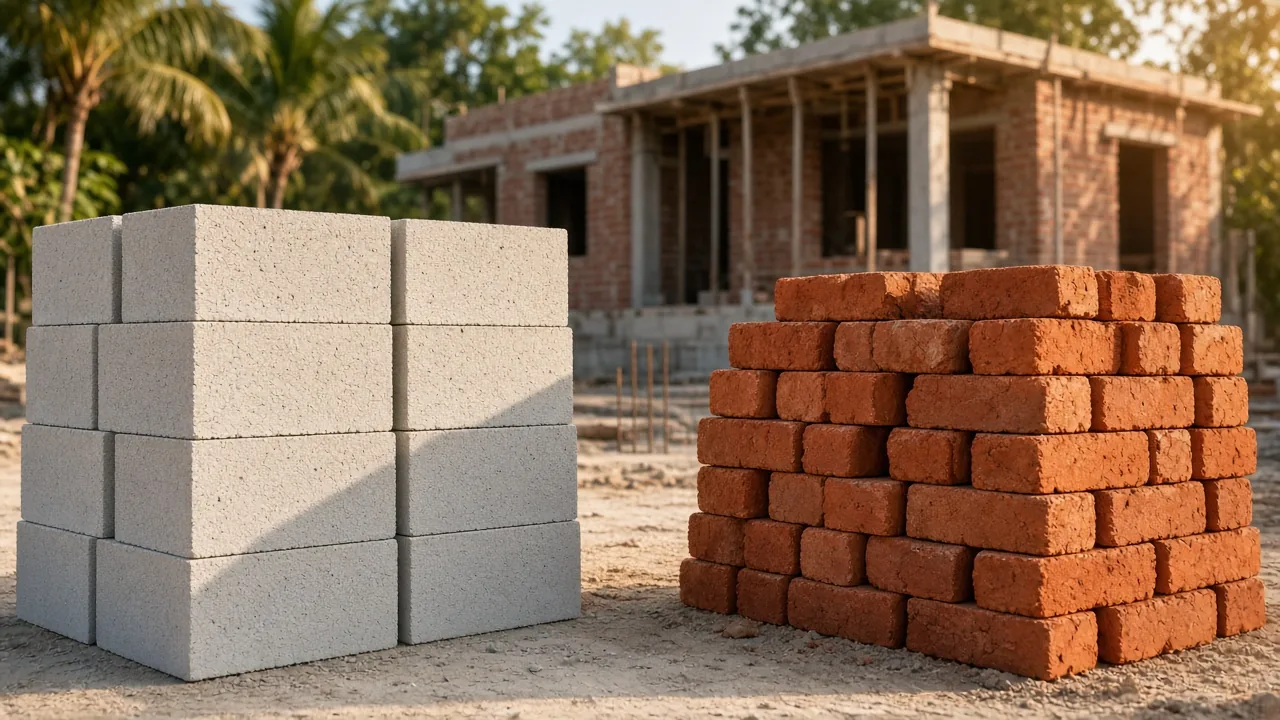
Quick answer
For modern RCC-framed homes in Chennai, AAC blocks outperform red bricks on the three counts that matter in Tamil Nadu’s climate: thermal insulation (cutting AC costs by 15–25%), construction speed (30–40% faster), and dead load (up to 65% lighter). Red clay bricks cost ₹9–12 per piece in 2026, while a standard 6-inch AAC block costs ₹60–70 — but one AAC block replaces 8–12 red bricks, so the wall-area cost gap is much smaller than the per-piece price suggests.
Every homeowner in Chennai hits this question at some point: AAC blocks, or the red bricks your parents used? Your contractor will have an opinion, your neighbour will have a different one, and you are left deciding what actually makes sense for a 2BHK in Sholinganallur or an independent house plot in Tambaram.
We have built over 400 homes across Chennai and seen both materials up close — the ones that hold up after the northeast monsoon, the ones that keep rooms cooler without the AC running all day, and the ones where the mason’s familiarity actually matters on site. This guide is that comparison, parameter by parameter. Where red bricks genuinely win, we say so.
What Exactly Are AAC Blocks — and Why Are They Different From Red Bricks?
What are AAC blocks?
AAC (autoclaved aerated concrete) is a factory-made, lightweight masonry block produced from fly ash, cement, lime, gypsum, and an aluminium powder aeration agent. The manufacturing process creates millions of tiny air pockets inside the block, and those air pockets are what give AAC its thermal and acoustic performance.
The blocks are cured under high pressure and temperature in an autoclave, which produces a dimensionally consistent product with a dry density of 550–650 kg/m³. That is roughly three times lighter than a red clay brick, which sits at 1,600–1,920 kg/m³.
What are red clay bricks?
Red clay bricks are traditional masonry units made from local clay and fired in a kiln. They have been the backbone of Indian construction for centuries — widely available, familiar to every mason in Chennai, and inexpensive at ₹9–12 per piece from Tamil Nadu suppliers in 2026. They are governed by IS 1077:1992.
Their compressive strength (3.5–7 N/mm²) is marginally higher than AAC (3–5 N/mm²) for load-bearing work. For the RCC-framed construction that makes up most of Chennai’s residential projects, that difference rarely matters in practice, because the wall is infill, not the structure.
If you are also comparing hollow clay blocks, our Porotherm bricks guide covers sizes, Chennai prices, and where they fit beside red brick and AAC.
How Do AAC Blocks and Red Bricks Actually Compare?
| Parameter | Red clay bricks | AAC blocks | Better for Chennai |
|---|---|---|---|
| Indian Standard | IS 1077:1992 | IS 2185 (Part 3):1984 | — |
| Common size | 230×115×75 mm | 600×200×100–200 mm | — |
| Density | 1,600–1,920 kg/m³ | 550–650 kg/m³ | AAC |
| Compressive strength | 3.5–7 N/mm² | 3–5 N/mm² | Red bricks (marginal) |
| Thermal conductivity | 0.6–1.0 W/m·K | 0.16–0.42 W/m·K | AAC |
| Water absorption | 15–20% | ≤10% | AAC |
| Fire resistance | About 2 hours | Up to 4 hours | AAC |
| Sound insulation | Low | About 42 dB reduction | AAC |
| Construction speed | Slower | 30–40% faster | AAC |
| Price per piece (2026) | ₹9–12 | ₹60–70 (6-inch) | Red bricks |
| Mortar | Thick bed, 12–15 mm | Thin bed, 2–3 mm | AAC |
| Mason familiarity | High — any mason | Moderate — trained mason | Red bricks |
| Plaster | Needs more plaster | Less plaster needed | AAC |
| Environmental impact | Uses agricultural topsoil | Uses fly ash (a waste product) | AAC |
One AAC block covers the wall area of about 9 red bricks, and typically 8–12 depending on the brick and block size you buy.
What Does the Full Wall-Area Cost Look Like?
The per-piece price is misleading without wall-area context. One 6-inch AAC block (600×200×150 mm) covers the same wall area as 9–12 red bricks. This is the cost picture for a typical Chennai residential project, per 1,000 sq ft of wall:
| Cost component | Red clay bricks | AAC blocks (6-inch) |
|---|---|---|
| Material (per 1,000 sq ft wall) | ~₹1,50,000 | ~₹1,65,000 |
| Labour (per 1,000 sq ft wall) | ~₹60,000 | ~₹55,000 (faster) |
| Mortar and plastering | Higher (thick joints) | Lower (thin adhesive) |
| Structural savings | — | Saves on steel and foundation |
| Approx. total (1,000 sq ft wall) | ~₹2,10,000 | ~₹2,20,000 |
| AC electricity over 10 years | — | ₹1–2 lakhs saved |
The upfront difference is small once you count wall area, not individual units. Where AAC wins clearly is the running cost — specifically the electricity bill through Chennai’s summer and the northeast monsoon.
Why Does Thermal Insulation Matter So Much in Chennai?
Chennai sits in a hot-humid coastal climate, with temperatures regularly hitting 38–42°C from March through June. The northeast monsoon then brings high humidity from October through December. The wall material is working against heat every hour of the day.
Red clay bricks have a thermal conductivity of 0.6–1.0 W/m·K. AAC blocks sit at 0.16–0.42 W/m·K, so an AAC wall transfers about three to four times less heat into the room. In a Chennai 3BHK, that difference can reduce the air-conditioning load by 15–25%.
Across projects in Velachery, Perumbakkam, and Sholinganallur, homeowners who chose AAC for external walls consistently report cooler rooms in peak summer. Over 10 years, the electricity saving on AC alone can come to ₹1–2 lakhs for a typical Chennai household.
From a Tambaram site
One client in Tambaram chose AAC blocks for a 1,800 sq ft G+1 house despite the slightly higher material cost. By year two, their summer electricity bill was running about 20% lower than the nearly identical red-brick house next door. The payback on the premium worked out to under three years.
Is AAC Faster — and Does It Hold Up in the Monsoon?
Construction speed
AAC blocks are 30–40% faster to lay than red bricks. A skilled mason covers 20–25 square metres a day with AAC, versus 12–15 square metres a day with red bricks. One block replaces 8–12 bricks, the joints are thin (2–3 mm against 12–15 mm), and the blocks are dimensionally precise, so there is less cutting on site.
For builders working under RERA deadlines in Tamil Nadu, that speed protects the handover date. On a typical 1,500 sq ft Chennai house, AAC masonry can save 4–6 days of wall construction compared with red brick.
Monsoon performance
By the time October and November are done, Chennai typically sees 500 mm or more of rain. Red bricks absorb 15–20% of their weight in water, which can lead to dampness, efflorescence (the white salt staining on older walls), and plaster cracking. AAC blocks absorb 10% or less by weight. The thin-bed adhesive joint also creates fewer water-ingress points than a thick mortar joint.
When Should You Still Choose Red Bricks?
Red bricks are not obsolete. These are the situations where we recommend each material on Chennai projects.
Choose AAC blocks when
- The house is RCC-framed, which is the standard for most Chennai homes
- You want cooler rooms without adding AC capacity
- The project is on a RERA deadline and wall completion has to move faster
- You want a flatter surface that needs less plaster
- The plot is waterlogged or low-lying — Pallikaranai and the Sholinganallur wetland fringes, for example
- You can source a supplier with site delivery (4-inch about ₹45–52 per piece, 6-inch ₹60–70)
Choose red bricks when
- The wall is traditional load-bearing masonry with no RCC frame — small outbuildings or compound walls
- The budget is tight and you want the lower upfront cost, with no special adhesive
- The plot is rural and AAC supply or a trained mason is not available
- A renovation or extension has to match an existing red-brick structure
- It is a compound or boundary wall, where thermal performance does not matter
HireAndBuild verdict
For a modern RCC-framed home anywhere in Chennai — a 1,200 sq ft house in Ambattur or a 3,000 sq ft G+2 on OMR — AAC is the better choice for the main walls. The upfront premium is small, the speed advantage is real, and the thermal performance pays back in lower electricity bills every year. We use AAC as the default for external walls on new residential builds. Red bricks earn the recommendation for compound walls, traditional load-bearing structures, and anywhere supply of the newer material is unreliable.
What Do BIS Standards Say About AAC Blocks in India?
AAC blocks in India are governed by IS 2185 (Part 3):1984, which specifies minimum compressive strength, dimensional tolerances, and density grades. For residential construction in Chennai, Grade 2 (dry density 501–650 kg/m³, compressive strength at least 3 N/mm²) is the usual specification.
Under IS 6041, the code for load-bearing AAC wall construction, the minimum thickness for an external load-bearing AAC wall is 200 mm, and 150 mm for internal walls. For RCC-framed buildings — the overwhelming majority of new homes in Chennai under CMDA and DTCP — the blocks are infill, not structural, so the IS 2185 Grade 2 specification covers the requirement.
When you compare supplier quotes, ask for the ISI certification number and the density grade. Some lower-cost AAC blocks in the Tamil Nadu supply chain fall below Grade 2 density, which affects both strength and insulation.
How Does Wall Material Change the Overall Construction Cost?
Wall material is one line in a larger cost breakdown. At HireAndBuild, 2026 construction cost in Chennai for standard quality runs ₹2,079–2,694 per sq ft. Masonry — the wall material plus labour — typically accounts for 10–15% of that total.
Moving from red bricks to AAC blocks on a 1,500 sq ft house adds roughly ₹30,000–50,000 to the masonry line. That is 1–2% of a ₹30-lakh construction budget. Lighter walls also reduce the steel and concrete in the RCC frame, so the net premium often drops further.
What moves the number more is the grade of AAC block, the thickness of external versus internal walls, and whether the mason uses adhesive or ordinary mortar. Those decisions belong at the planning stage, not mid-construction. A free cost estimate is the cleanest way to see the difference on your own plan.
Frequently Asked Questions
Are AAC blocks stronger than red bricks?
Red clay bricks have marginally higher compressive strength — 3.5–7 N/mm² versus 3–5 N/mm² for AAC. For RCC-framed construction, which covers nearly all modern homes in Chennai, the wall is infill and not structural, so the difference has no practical impact. Compressive strength of the masonry unit becomes a selection factor only for traditional load-bearing masonry without an RCC frame.
What is the price of AAC blocks in Chennai in 2026?
In Chennai in 2026, 4-inch AAC blocks cost ₹45–52 per piece and 6-inch (150 mm) blocks cost ₹60–70 per piece from bulk suppliers with site delivery. The 6-inch size is the one most often specified for external walls. Red clay bricks cost ₹9–12 per piece, but one AAC block covers the same wall area as 9–12 red bricks, so the per-piece price overstates the gap.
Do AAC blocks need special mortar or adhesive?
Yes. AAC blocks need thin-bed adhesive mortar (2–3 mm joints) rather than the cement-sand mortar used for red bricks (12–15 mm joints). The adhesive is typically a polymer-modified cementitious product. Regular mortar on AAC creates thick joints that become thermal bridges and cancel the insulation advantage. A mason who has not worked with AAC will often default to those thick joints, which is why familiarity matters.
Are AAC blocks good for Chennai’s climate?
Yes. Thermal conductivity of 0.16–0.42 W/m·K is three to four times better than red bricks (0.6–1.0 W/m·K), which cuts heat gain through external walls. In March–June that can mean a 15–25% lower air-conditioning load. Lower water absorption (10% or less, against 15–20% for red bricks) also makes AAC more resilient in the northeast monsoon, with less damp and efflorescence risk in places such as Velachery and Sholinganallur.
Which CMDA and BIS standards apply to AAC block construction in Chennai?
AAC blocks in India are manufactured to IS 2185 (Part 3):1984. For homes in Chennai under CMDA and DTCP, Grade 2 AAC (dry density 501–650 kg/m³, compressive strength at least 3 N/mm²) meets the requirement for infill walls in an RCC-framed building. Load-bearing AAC wall design follows IS 6041. CMDA building regulations follow the Tamil Nadu Combined Development and Building Rules (TNCDBR).
How much faster is AAC block construction than red brick?
AAC walls go up 30–40% faster on the same site. A trained mason lays 20–25 sq m of AAC wall a day versus 12–15 sq m of red brick. Each block covers the area of 8–12 bricks, the thin adhesive joints set faster than thick mortar, and factory-made blocks need less cutting. On a typical 1,500 sq ft Chennai house, that can save 4–6 days of wall construction.
Are AAC blocks eco-friendly compared with red bricks?
AAC has a lower environmental impact on two counts. It uses fly ash, a by-product of thermal power plants, instead of agricultural topsoil. Red clay brick production has also been progressively regulated in Tamil Nadu because of soil excavation on agricultural land and floodplains. AAC production generates fewer carbon emissions per unit of wall area built.
Can AAC blocks be used for compound walls and boundary walls in Chennai?
Technically yes, but we do not recommend it as the default. Compound walls are typically single-leaf, exposed, and at risk of impact. Red bricks or hollow concrete blocks are more cost-effective for boundary walls, because AAC’s insulation advantage does not apply and the cost premium is hard to justify.
Planning a house in Chennai? Get the wall material priced into your estimate
HireAndBuild builds turnkey homes across Chennai. We specify AAC for external walls on new RCC-framed houses, and red brick where a compound wall or a load-bearing structure is the better fit.