
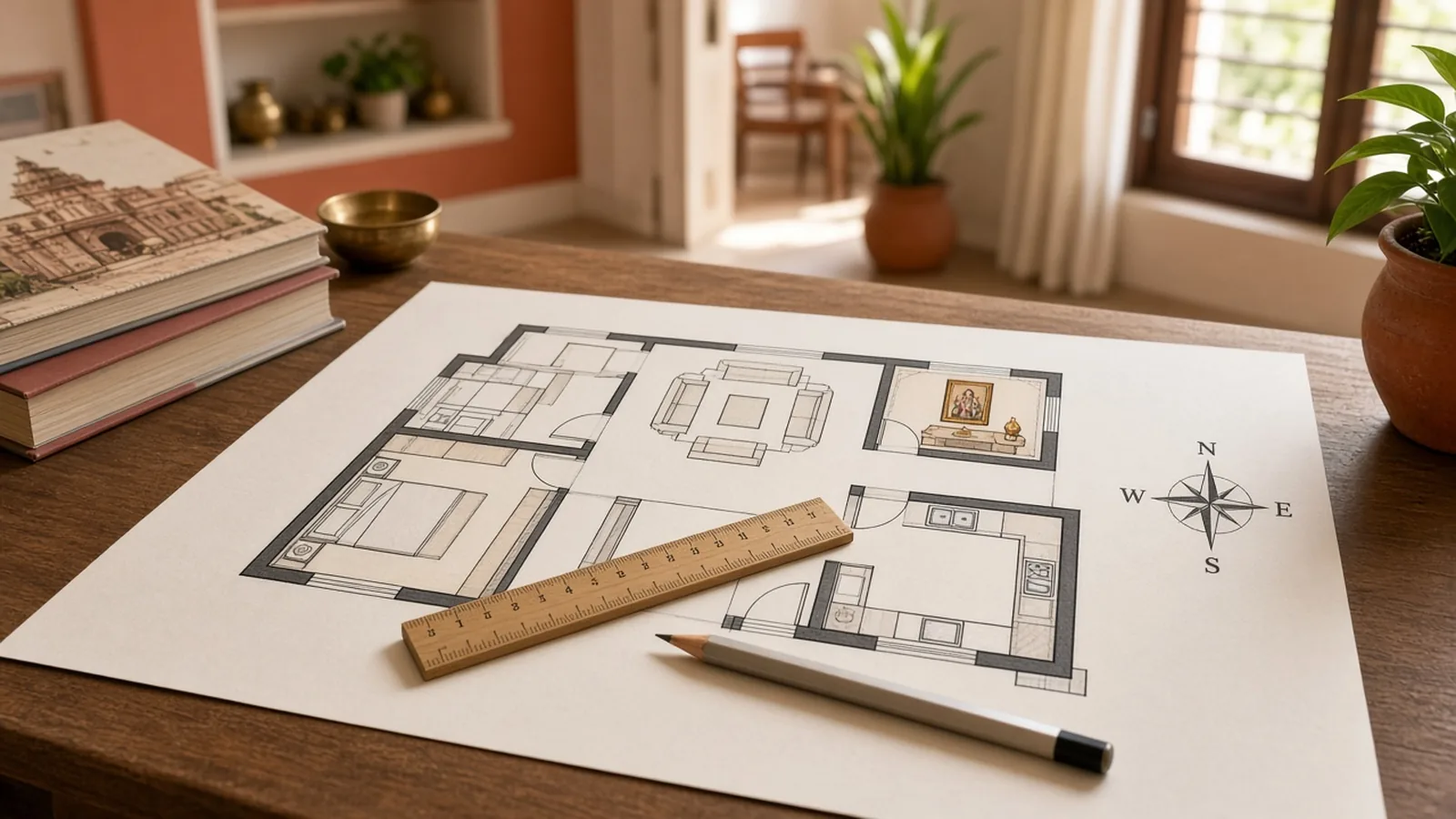
Vastu Shastra for House Construction in Chennai (2026) — Complete Room-by-Room Guide
By HireAndBuild Team
Last Updated: September 2026 | 15 min read
⚡ Quick Answer — Vastu for House Construction
Vastu shastra for house construction covers the ideal placement for every room. Key rules for Chennai homes: Main door — North or East. Kitchen — South East (Agni corner). Master bedroom — South West. Pooja room — North East. Bathroom — South or West. Staircase — South or West side of the house. Applied at the floor plan stage, vastu compliance costs nothing extra.
At HireAndBuild, almost every client who builds a home in Chennai asks us about vastu shastra for house construction before finalising their floor plan. And rightly so — vastu for house planning costs nothing when applied at the design stage, but can be expensive or impossible to fix after construction. This complete guide covers vastu for house design room by room — as per vastu shastra: main door direction, kitchen placement, master bedroom location, pooja room vastu, bathroom direction, staircase position, sump and overhead tank placement — based on our experience delivering 250+ homes across Chennai since 2020. We also address the most common vastu myths that cause homebuilders in Chennai to make costly mistakes.
Vastu for All Rooms — Quick Reference Table (As Per Vastu Shastra 2026)
As per vastu shastra, here is the correct placement for every room in a Chennai home. Apply this during your floor plan stage before construction begins:
| Room / Element | Best Location as per Vastu | Strictly Avoid |
|---|---|---|
| Main Door | North or East | South West |
| Kitchen | South East (Agni corner) | North East |
| Master Bedroom | South West | North East |
| Pooja Room | North East | South or South West |
| Bathroom / Toilet | South or North West | North East |
| Staircase | South or West | North East, Centre |
| Underground Sump | North East corner of plot | South West |
| Overhead Tank | South West corner of terrace | North East of terrace |
In this guide
- What is vastu shastra for house construction?
- Main door vastu — best directions
- Kitchen vastu — direction and placement
- Master bedroom vastu — location rules
- Pooja room vastu — placement and facing
- Bathroom and toilet vastu
- Staircase vastu — direction and steps
- Sump, overhead tank and septic tank vastu
- Vastu for north, south, east, west facing houses
- Vastu myths vs facts — debunked
- FAQs
What Is Vastu Shastra for House Construction?
Vastu shastra is an ancient Indian science of architecture that aligns a building with the five natural elements — earth, water, fire, air and space — and the eight directions. Applied during house construction, vastu influences where each room is placed, which direction doors and windows face, and how spaces are arranged to promote wellbeing.
Vastu is most powerful and cost-free when applied at the floor plan stage — before construction begins. Changing room positions after walls are built can cost ₹50,000–₹5,00,000 depending on the change. Check that range against a free house construction cost calculator before you freeze the drawing. At HireAndBuild, house construction in Chennai includes a review of our clients’ floor plans for basic vastu compliance during the architectural design stage at no extra charge.
- North (Kubera) — wealth and career
- South (Yama) — stability and ancestors
- East (Indra) — health and sunrise energy
- West (Varuna) — water and gains
- North East (Ishanya) — spirituality, best for pooja room
- South East (Agni) — fire element, best for kitchen
- South West (Nairuti) — earth element, best for master bedroom
- North West (Vayu) — air, movement
Which Direction Is Best for Main Door as Per Vastu?
As per vastu shastra, North and East are the best directions for the main door. North East is also highly auspicious — these directions bring positive energy and prosperity into the house.
The main door is the most important vastu element in any home. It controls the flow of energy into the house.
Best main door directions (in order):
- North — governed by Kubera (wealth). Best for prosperity.
- East — governed by Indra (health). Best for energy and sunlight.
- North East — highly auspicious. Spiritual energy enters the home.
- West — acceptable. Governed by Varuna.
Avoid for main door:
- South — governed by Yama. Generally avoided in traditional vastu.
- South West — considered most inauspicious for main entrance.
- South East — Agni corner, not ideal for entrance.
| Direction | Vastu Result | Recommended? |
|---|---|---|
| North | Wealth, career | Excellent |
| East | Health, energy | Excellent |
| North East | Spiritual | Excellent |
| West | Gains, water | Acceptable |
| North West | Air, movement | Acceptable |
| South | Stability | Avoid |
| South East | Fire energy | Avoid |
| South West | Earth, heavy | Avoid |
In Chennai’s CMDA and DTCP layouts, plots often face east or north due to road alignment — this is naturally vastu-compliant. South-facing plots on main roads are common in areas like Anna Nagar and Tambaram. A south-facing plot doesn’t automatically mean vastu problems — the main door placement within the south face matters. Consult your architect during the plan stage. If the drawing still needs sanction, start with building plan approval in Chennai.
— HireAndBuild Team
Which Direction Should the Kitchen Face as Per Vastu Shastra?
As per vastu shastra, the kitchen should be in the South East corner — the Agni (fire) corner. This applies to all houses regardless of which direction the house faces.
The kitchen represents the fire element (Agni) in vastu. Its ideal placement is in the South East corner — the Agni corner — of the house.
Kitchen direction rules:
- Best: South East corner of the house
- Acceptable: North West corner
- Avoid: North East (sacred/spiritual zone)
- Avoid: South West (master bedroom zone)
- Avoid: directly opposite the main door
The cook should ideally face East while cooking.
| Kitchen Location | Vastu Rating | Why |
|---|---|---|
| South East | Best | Agni corner, fire element |
| North West | Acceptable | Air element, usable |
| East | Acceptable | Faces morning sun |
| North East | Avoid | Sacred zone |
| South West | Avoid | Earth/master zone |
| North | Avoid | Wealth zone, avoid fire |
In Chennai’s urban plots where the site is 30×40 or smaller, placing the kitchen in the exact South East corner is not always possible due to CMDA setback rules and road alignment. In these cases, we work with the architect to get as close to South East as the approved plan allows. A slight deviation is acceptable — an exact North East kitchen is the only placement we actively work to avoid.
— HireAndBuild Team
Where Should the Master Bedroom Be Placed as Per Vastu?
As per vastu, the master bedroom should be in the South West corner of the house. This is the earth element zone — heavy and stable energy that promotes deep sleep and stability.
The master bedroom represents the most important sleeping and resting space. In vastu, it should be in the heaviest, most stable part of the house.
Best master bedroom location: South West — the earth corner. Heavy, stable energy. Promotes deep sleep and stability.
Sleeping direction inside the bedroom:
- Head pointing South — considered best in vastu. The body aligns with the earth’s magnetic field.
- Head pointing East — acceptable.
- Head pointing North — avoid (magnetic pull towards head disturbs sleep per vastu).
| Location | Vastu Rating | Notes |
|---|---|---|
| South West | Best | Stability, earth energy |
| South | Good | Acceptable |
| North West | Okay | Movement/air, less stable |
| North East | Avoid | Spiritual zone, not for sleep |
| South East | Avoid | Fire zone, restless sleep |
For G+1 houses in Chennai: If building a G+1, the master bedroom on the upper floor South West corner is ideal. The ground floor South West can be used for a storeroom or another bedroom.
Which Corner Is Best for Pooja Room as Per Vastu Shastra?
As per vastu shastra, the North East corner is the best location for the pooja room. This zone receives morning sun and carries the highest spiritual energy in the house.
The pooja room is the spiritual centre of the home. Vastu is very specific about its placement.
Ideal pooja room location: North East corner — the Ishanya zone. Highest spiritual energy. Morning sun enters from this direction.
Pooja room facing direction: The idol/deity should face West or East. The person praying faces East or West. Avoid idols facing South.
Pooja room floor level: Should be at the same level as the main floor or slightly raised. Never in the basement.
What to avoid near pooja room:
- Bathroom above or adjacent to pooja room
- Bedroom sharing a wall with the pooja room’s idol placement wall
- Kitchen directly adjacent (fire near sacred space)
In compact Chennai urban plots (30×40 sqft), a separate pooja room is often not feasible. Acceptable alternatives: a dedicated pooja alcove in the North East corner of the living room, or a built-in wall mandir facing West.
Where Should Bathroom and Toilet Be Placed as Per Vastu?
As per vastu, bathrooms and toilets should be in the South, South West or North West zones. The North East corner must strictly be avoided — it destroys the spiritual energy of that sacred zone.
Bathrooms and toilets should be placed in the less auspicious zones of the house to contain their negative energy.
Best bathroom/toilet locations:
- South or South West (for attached bathroom)
- North West (for common bathroom)
- West (acceptable)
Worst bathroom/toilet locations:
- North East — destroys spiritual energy of the sacred zone
- Centre of the house (Brahmasthan) — never place any heavy structure here
- South East — fire and water clash
Toilet seat direction: Person should face North or South while using the toilet. Avoid facing East (sacred direction) or West.
Modern Chennai apartment-style independent houses often have attached bathrooms to each bedroom. When the master bedroom is in South West, its attached bathroom should be in the South or West side of that bedroom — this is usually achievable within standard floor plan layouts.
— HireAndBuild Team
What Is the Vastu for Staircase — Direction, Position and Number of Steps?
As per vastu, the staircase should be on the South or West side of the house. Avoid placing it in the North East corner or at the centre of the house.
The staircase allows energy to move between floors. Its placement affects the flow of prosperity and health in the house.
Best staircase positions:
- South side of the house
- West side
- South West corner
Avoid staircase in:
- North East — blocks spiritual energy
- Centre of house — blocks Brahmasthan energy
- Directly in front of main door
Staircase direction of climb: Should go from East to West, or North to South. Ideally, you climb the staircase while facing West.
Number of steps: Traditional vastu recommends an odd number of steps (1, 3, 5, 7, 9, 11…). The last step when you count should end on 1, 3, 5, or 7 (not 0 or an even number).
Typical G+1 homes in Chennai have 14–18 steps depending on ceiling height. We design the staircase to comply with vastu step count during the structural design phase — this is easy to incorporate when planned upfront and costs nothing extra.
— HireAndBuild Team
Where Should the Sump, Overhead Tank and Septic Tank Be as Per Vastu?
As per vastu, the underground sump should be in the North East corner of the plot and the overhead tank in the South West corner of the terrace.
This section is written from HireAndBuild site practice — water storage vastu for Chennai plots, not a generic national checklist.
Underground sump: Best location is the North East corner of the plot, because the water element aligns with North East’s spiritual energy. Avoid the South West (earth/stability zone — water weakens it).
Overhead tank: Best location is the South West corner of the terrace, the heavy element in the heaviest zone. Avoid the North East corner of the terrace.
Septic tank: Best location is North West or South of the plot. Keep a minimum distance of 3 metres from the main building (also required by CMDA for plan approval). Avoid North East, directly under a bedroom, or under the pooja room.
Borewell: Best location is the North East corner of the plot.
Chennai’s water table depth varies significantly by area — Velachery and Medavakkam have higher water tables than Porur or Poonamallee. We recommend soil testing before borewell placement regardless of vastu direction, since practical water availability must take precedence over direction when the two conflict. For west-Chennai plots, see house construction in Porur.
— HireAndBuild Team
What Is the Vastu for North, South, East and West Facing Houses?
| Direction | Main Door | Kitchen | Master Bed | Pooja Room |
|---|---|---|---|---|
| North | North | South East | South West | North East |
| East | East | South East | South West | North East |
| South | South* | South East | South West | North East |
| West | West | South East | South West | North East |
*For south facing homes, door placement within the south face requires specific pada calculation.
Kitchen, master bedroom and pooja room locations are the same regardless of house facing direction — only the main door changes.
For a full guide on east facing house vastu with floor plans, see our east facing house vastu plan guide.
Vastu Myths vs Facts — What Chennai Homebuilders Get Wrong
Myth: “South facing house is always bad vastu.”
Fact: South facing houses are common and perfectly acceptable in vastu. What matters is where within the south face the main door is placed. Many auspicious pada positions exist on the south face.
Myth: “You cannot build a vastu-compliant home on an irregular plot.”
Fact: L-shaped and irregular plots can be vastu-compliant. The missing corner determines what the homeowner should compensate for in room placement. A vastu consultant or experienced architect can guide this.
Myth: “Vastu requires major structural changes that add cost.”
Fact: 90% of vastu compliance is achieved during the floor plan stage at zero extra cost. Only after-construction corrections are expensive. HireAndBuild incorporates basic vastu review into our architectural design process at no extra charge.
Myth: “The pooja room must always be a separate full room.”
Fact: On smaller Chennai plots (30×40 sqft), a vastu-compliant pooja alcove in the North East corner of the living room works perfectly well.
Myth: “North facing houses are always the best for vastu.”
Fact: North facing is one of the best options but East facing and North East facing are equally auspicious. The best direction depends on the owner’s horoscope according to traditional vastu — a site’s overall energy matters more than just facing direction.
Myth: “Vastu conflicts with CMDA approved plans.”
Fact: CMDA approved plans in Chennai follow setback and FAR rules — these rarely conflict with vastu. Room placement within the approved footprint can almost always be optimised for vastu compliance.
Frequently Asked Questions — Vastu Shastra for House Construction in Chennai
Build a Vastu-Compliant House in Chennai — Get Free Consultation
HireAndBuild includes basic vastu review in our architectural design process across all packages. We have applied vastu principles across 250+ homes in Chennai and outskirts including Porur, Poonamallee, Guduvancheri, Tambaram and 15 more localities.
Our construction packages:
- Basic: ₹1,999/sqft
- Standard: ₹2,299/sqft
- Premium: ₹2,649/sqft
- Luxury: ₹2,999/sqft
Compare construction cost per sqft in Chennai before you lock a package.
Basic vastu review is included in architectural design on every package.