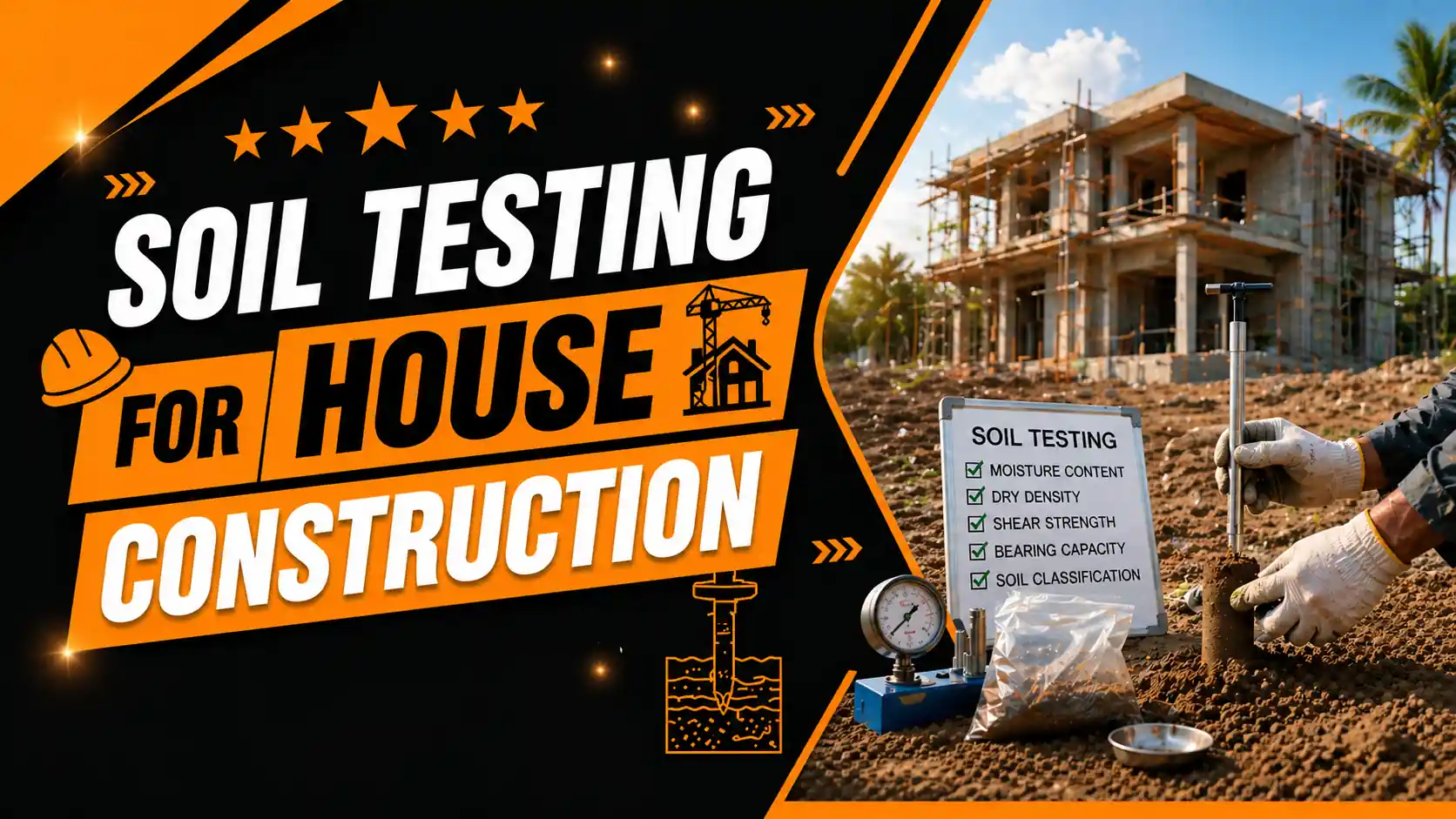
Soil Testing for House Construction in Chennai: What Every Homeowner Must Know
Your plot looks perfectly ordinary from the surface. But six feet below, the soil tells a completely different story. You might be sitting on expansive clay that swells every monsoon season. Or coastal soil quietly loaded with chlorides that will corrode your TMT bars over time. That is why soil testing is not paperwork — it is the single most important thing you do before a drop of concrete is poured.
Soil testing for house construction in Chennai is a pre-construction geotechnical investigation that measures Safe Bearing Capacity (SBC), soil type, moisture content, and chemical composition to determine the correct foundation design before any digging starts.
- Cost in Chennai (2026): ₹13,500–₹16,500 per borehole point (NABL-accredited, CMDA-approved). Most plots need 2–3 points — total ₹27,000–₹50,000. See a full breakdown of house construction costs in Chennai →
- Depth: 13–15 metres for G+2 residential projects. Minimum 10M for G+1.
- Tests included: Standard Penetration Test (SPT), SBC calculation, moisture content, Atterberg limits.
- Time: 5–7 working days from site visit to CMDA-format report.
- CMDA requirement: Mandatory for multi-floor buildings in Chennai. Non-NABL reports are rejected. Read our complete guide to building plan approval in Chennai →
- Highest-risk zones: Thoraipakkam, Pallikaranai (SBC 60–100 kN/m²), Velachery, Medavakkam (expansive clay).
- Minimum SBC for G+1: 100–120 kN/m² for isolated footings. Below 100 requires raft or pile foundation.
HireandBuild has completed 400+ residential projects across Chennai — from Anna Nagar to OMR, Ambattur to Thoraipakkam. We have seen firsthand what happens when soil testing is skipped. Remediation work on one Velachery G+2 project cost ₹14 lakhs — more than ten times what the soil test would have cost. Use our free online construction cost calculator to understand how foundation type affects your total build budget.
Here is what this guide covers:
- Why soil testing is non-negotiable before construction in Chennai
- What each test actually measures and what the results mean for your foundation
- A zone-by-zone breakdown of Chennai's soil types — no other guide covers this in this detail
- Exactly what a CMDA-approved soil report must include
- Precise costs for 2026 and how to read your report without an engineering degree
Not sure what kind of soil is under your Chennai plot? Our geotechnical team can walk you through it before you finalise any design decisions.
No obligation — just a conversation about your plot.A homeowner in Perumbakkam received three contractor quotes for her 1,200 sq ft G+1 home. All three listed similar foundations and roughly 500 bags of cement. She chose the cheapest. Three months later, she was told her plot needed a raft foundation — and the original estimate was "just a planning figure." The variation order was ₹1.8 lakhs. A ₹15,000 soil test before any quote was signed would have changed every decision that day. This happens to Chennai homeowners every single week. It does not have to happen to you.
What Is Soil Testing and Why Does It Matter for Your Chennai Home?
Soil testing — formally called geotechnical investigation — analyses the physical and chemical properties of the ground at your site before any excavation begins. The goal is straightforward: confirm whether the earth beneath your home can safely carry the weight you plan to build above it.
This is not optional in Chennai. The city sits on highly variable geology. Within a single kilometre, you can move from hard laterite rock to water-saturated clay. Thoraipakkam's soil was historically marshland. Coastal zones along OMR carry chloride and sulfate levels that corrode reinforcement steel quietly over years. Building without knowing your soil type is not construction — it is a calculated gamble.
Soil testing identifies five things that determine every foundation decision: bearing capacity, soil type, moisture content, groundwater level, and chemical composition. Each one affects your structural engineer's choices — and directly impacts your final budget. Want to understand how these costs add up? Try our free house construction cost calculator to see how foundation decisions affect your total project cost.
Here is exactly what each of those five parameters measures and why your engineer cannot work without them.
What Does a Soil Test Actually Measure? The Five Parameters That Matter
- Safe Bearing Capacity (SBC) — the most important number: Measured in kN/m², SBC is the maximum load the soil can carry per square metre without failing in shear or settling excessively. This single number tells your structural engineer whether you need isolated footings, a raft foundation, or a pile foundation.
- Moisture Content: High moisture in Chennai's clay-heavy soils causes the ground to expand and contract with each monsoon cycle. This drives differential settlement — where different parts of the foundation shift at different rates, eventually cracking walls and beams.
- Soil Type and Classification: Whether your site has laterite, alluvial deposit, expansive black cotton clay, or reclaimed fill determines every design choice. Sieve analysis and Atterberg Limit tests classify this precisely under BIS IS 1892 protocols.
- Groundwater Table Level: In low-lying areas like Velachery and Pallikaranai, the water table can sit just 2–3 metres below ground. This affects how deep your foundation must go, what waterproofing is needed, and how your PCC mix is designed.
- Chemical Composition — Chloride and Sulfate Content: The silent risk along Chennai's coastal belt — OMR, Perungudi, Sholinganallur. Elevated salt levels accelerate corrosion of TMT bars (Fe 415/500) and degrade concrete over time. The fix is upgrading to M25 concrete and epoxy-coated bars — but only if you know the problem exists first.
Types of Soil Tests for House Construction in Chennai — and When Each Is Required
Not every project needs every test. Here is the full picture — what each test does, when it is needed, and what it costs from NABL-accredited labs in Chennai:
| Test | What It Measures | When It Is Required | Approx. Cost (2026) |
|---|---|---|---|
| Standard Penetration Test (SPT) | N-value (soil resistance) at each metre of depth; used to calculate SBC | Every residential project — mandatory for CMDA plan approval | Included in borehole package |
| Plate Load Test (PLT) | Direct bearing capacity under a static load — highest accuracy available | G+2 and above; soft soil zones like Thoraipakkam | ₹8,000–₹12,000 per test |
| Atterberg Limits | Soil plasticity — how clay behaves when moisture changes | Clay-heavy zones: Velachery, Medavakkam | Included in lab analysis |
| Moisture Content Test | Current water content in the soil sample | All projects | Included in standard package |
| Compaction Test (Proctor Test) | Maximum dry density; how much the fill soil can be compacted | Fill areas, soft soil stabilisation projects | ₹2,000–₹3,500 per sample |
| Grain Size / Sieve Analysis | Particle size distribution — gravel, sand, silt, and clay ratio | Sandy zones: OMR, Ambattur | Included in lab analysis |
| Chemical Analysis — Chloride & Sulfate | Corrosive salt levels that damage concrete and TMT reinforcement bars | Coastal areas: OMR, Sholinganallur, Perungudi — always include this | ₹1,500–₹3,000 per sample |
| Permeability Test | Rate of water movement through soil — needed for drainage design | Waterlogged areas, projects with basements | ₹2,000–₹4,000 per sample |
| Rates from NABL-accredited labs in Chennai as of early 2026. Confirm pricing with your chosen lab before commissioning work. | |||
For a standard 2BHK or 3BHK going up to G+2, the essential package is the SPT borehole investigation combined with laboratory analysis. This gives you the N-value at every metre — the foundation of every SBC calculation your structural engineer will make. See our turnkey construction services page to understand how soil investigation fits into the complete build process.
Chennai Soil Types by Location: What Is Actually Under Your Plot?
Chennai's geology is not uniform. A foundation that works perfectly in Tambaram can be structurally inadequate in Velachery — even for the same floor plan and total load. Here is a zone-by-zone breakdown based on geotechnical data from across the city:
| Area / Zone | Soil Type | Typical SBC (kN/m²) | Risk Level | Typical Foundation Required |
|---|---|---|---|---|
| Velachery | Expansive Clay | 80–120 | HIGH waterlogging, settlement | Raft or pile foundation |
| Thoraipakkam / Pallikaranai | Reclaimed Marshland / Soft Clay | 60–100 | VERY HIGH high water table, liquefaction risk | Deep pile foundation — mandatory |
| Medavakkam | Expansive Clay | 80–130 | HIGH shrinks in summer, swells in monsoon | Raft with plinth beam |
| OMR / Sholinganallur / Perungudi | Coastal Alluvial + Sandy Clay | 100–150 | MEDIUM-HIGH chloride/sulfate risk | Isolated footing + chemical testing essential |
| Perambur / Kolathur | Alluvial with Clay Pockets | 100–160 | MEDIUM variable plot to plot | Isolated footing — verify depth carefully |
| Anna Nagar / Kilpauk | Laterite / Red Loam | 150–200 | LOW-MEDIUM relatively stable | Isolated footing at standard depth |
| Ambattur / Avadi | Mixed Laterite + Sandy | 140–190 | LOW-MEDIUM good drainage | Isolated footing |
| Chromepet / Pallavaram | Red Sandy Soil | 160–220 | LOW stable, good bearing | Isolated footing — cost-efficient build |
| Tambaram / Guduvanchery | Red Loam + Hard Rock (patches) | 180–250+ | LOW hard rock zones reduce excavation cost | Isolated footing or rock anchor |
| General observations from geotechnical surveys across Chennai. Soil conditions can vary even within the same street — every plot must be independently tested. Use this table for planning context, not as a substitute for a site investigation. | ||||
Important — Thoraipakkam and Pallikaranai: These zones carry an additional risk that most guides miss: elevated soil liquefaction potential during seismic events. The soft, saturated fill material behaves unpredictably under ground movement. This is why pile foundations here are a structural requirement — not just a conservative design preference.
We have built homes across every zone in this table. Before we draw a single structural line, we commission zone-appropriate soil investigation — so your foundation is designed for what is actually under your plot. View our full range of construction services →
Free site assessment — tell us your location and we will take it from there.What Is a CMDA-Approved Soil Test Report — and Do You Need One?
If you are building within CMDA (Chennai Metropolitan Development Authority) jurisdiction — which covers most of Greater Chennai and many surrounding areas — your structural engineer cannot submit a building plan for approval without a CMDA-compliant soil investigation report. Our complete guide to building plan approval in Chennai walks through every document required at each stage of the CMDA submission process.
Under RERA Tamil Nadu, builders selling residential units must also disclose geotechnical data — adding a second compliance layer beyond just plan approval. For plots under DTCP jurisdiction (Tambaram, Guduvanchery, newer peripheral developments), the requirements are similar but submitted to a different authority.
A CMDA-approved report is not the same as a generic soil certificate. Here is exactly what it must contain:
- Borehole log showing depth, soil description, and N-value at each metre (per BIS IS 2131)
- Safe Bearing Capacity (SBC) value calculated at the proposed foundation depth
- SPT N-values at each critical depth interval
- Laboratory results for moisture content, specific gravity, and Atterberg Limits
- NABL-accredited lab stamp on every page of the report
- Foundation recommendation signed by a qualified geotechnical engineer — not just a technician
A lot of homeowners accept a basic soil certificate from a non-NABL lab for ₹3,000–₹5,000 to save money. CMDA rejects these during plan approval — every time. Always confirm NABL accreditation before you commission any test. Verify the certificate number at nabl.gov.inOfficial. For a full walkthrough of the CMDA plan approval process and what documents are required, read our building plan approval guide.
How Much Does a Soil Test Cost in Chennai in 2026?
Here is the honest picture — because almost no one in this industry will give it to you upfront. Soil testing in Chennai ranges from ₹6,000 for a shallow basic investigation to over ₹35,000 for comprehensive geotechnical work on coastal or difficult plots. The primary cost driver is borehole depth and the number of test points your plot needs.
For a standard G+2 residential project requiring a CMDA-approved report, expect to pay ₹13,500–₹16,500 per borehole point at 13–15 metre depth. Most plots need 2–3 test points for a complete site picture. To see how soil testing fits into your total construction budget, use our free construction cost calculator or read the detailed house construction cost guide for Chennai.
| Project Type | Borehole Depth | Tests Included | Approx. Cost (2026) |
|---|---|---|---|
| Ground floor only (G+0) | 6–8 metres | SPT, Moisture, SBC | ₹6,000–₹10,000 |
| G+1 — standard residential | 10–12 metres | SPT, SBC, Atterberg Limits, Moisture | ₹10,000–₹14,000 |
| G+2 / G+3 — CMDA plan required | 13–15 metres | SPT + SBC + NMT, CMDA-format report | ₹13,500–₹16,500 per point |
| G+3 and above / Soft soil zones | 15–20 metres+ | Full geotechnical report + PLT + Chemical | ₹20,000–₹35,000+ |
| Coastal plots — OMR, Perungudi | 13–15 metres + chemical | Above + Chloride & Sulfate analysis | ₹16,000–₹22,000 |
| Rates from NABL-accredited labs serving Chennai, Chengalpattu, and Thiruvallur districts — early 2026. Confirm with your chosen lab before commissioning. | |||
What increases your quote: restricted plot access for drilling equipment, coastal plots needing separate chemical analysis, soft-soil zones requiring deeper boreholes, and G+3+ projects needing a Plate Load Test on top of SPT.
Our pre-construction package includes CMDA-approved soil investigation at itemised, transparent pricing. You see every line before work begins — no surprises.
We will tell you exactly what your plot needs and what it will cost.How to Read Your Soil Test Report: N-Value, SBC, and What the Numbers Mean
Your report arrives. It is twelve pages long, full of graphs, borehole logs, and abbreviations you have never seen before. Here is how to read the two numbers that matter most.
The N-Value — Soil Resistance at Every Depth
The N-value is the number of blows required to drive a sampling tube exactly 300mm into the soil at a given depth. Low N-values = weak soil. High N-values = strong soil. These are the thresholds your engineer works from:
- N below 10 Very loose or soft — soil stabilisation required before any foundation work
- N = 10–30 Medium density — footings are possible at appropriate depth with careful design
- N = 30–50 Dense soil — good bearing capacity; standard isolated footings are fine
- N above 50 (refusal) Very dense or rock — excellent bearing; may need special excavation equipment
The SBC Value — Your Foundation Design Number
SBC (Safe Bearing Capacity) is derived from N-values and represents the maximum load in kN/m² the soil can carry safely. This is the number your structural engineer uses to size and specify your foundation system.
| SBC (kN/m²) | Soil Quality | What It Means for Your Build | Foundation Decision |
|---|---|---|---|
| Above 200 | Excellent / Hard | Ideal — stable, any structure suitable | Standard isolated footing at 1.2–1.5M |
| 150–200 | Good | Suitable for G+1 through G+3 | Standard isolated footing at 1.5–2M |
| 100–150 | Moderate | Workable — needs more careful design | Deeper footing (2–2.5M) or combined footing |
| 60–100 | Weak / Soft | Cannot carry standard loads safely | Raft foundation or pile foundation required |
| Below 60 | Very Weak | High settlement and failure risk | Deep pile foundation + soil stabilisation |
If your report shows SBC of 120 kN/m² in Velachery, your engineer will specify a raft foundation — one continuous concrete slab rather than individual column footings. This spreads the load over a larger area to stay within safe limits. It adds ₹1.5–3 lakhs to your foundation cost. But it is the only structurally responsible option, and knowing this before any quote is agreed saves you from a painful variation order later. Use our construction cost calculator to model how foundation type affects your total project spend.
What Happens If Your Soil Test Result Is Bad? Your Options Explained
A poor result does not mean you cannot build. It means the engineering solution is different from what a standard plot would need. These are the six approaches engineers use on Chennai sites with difficult soil:
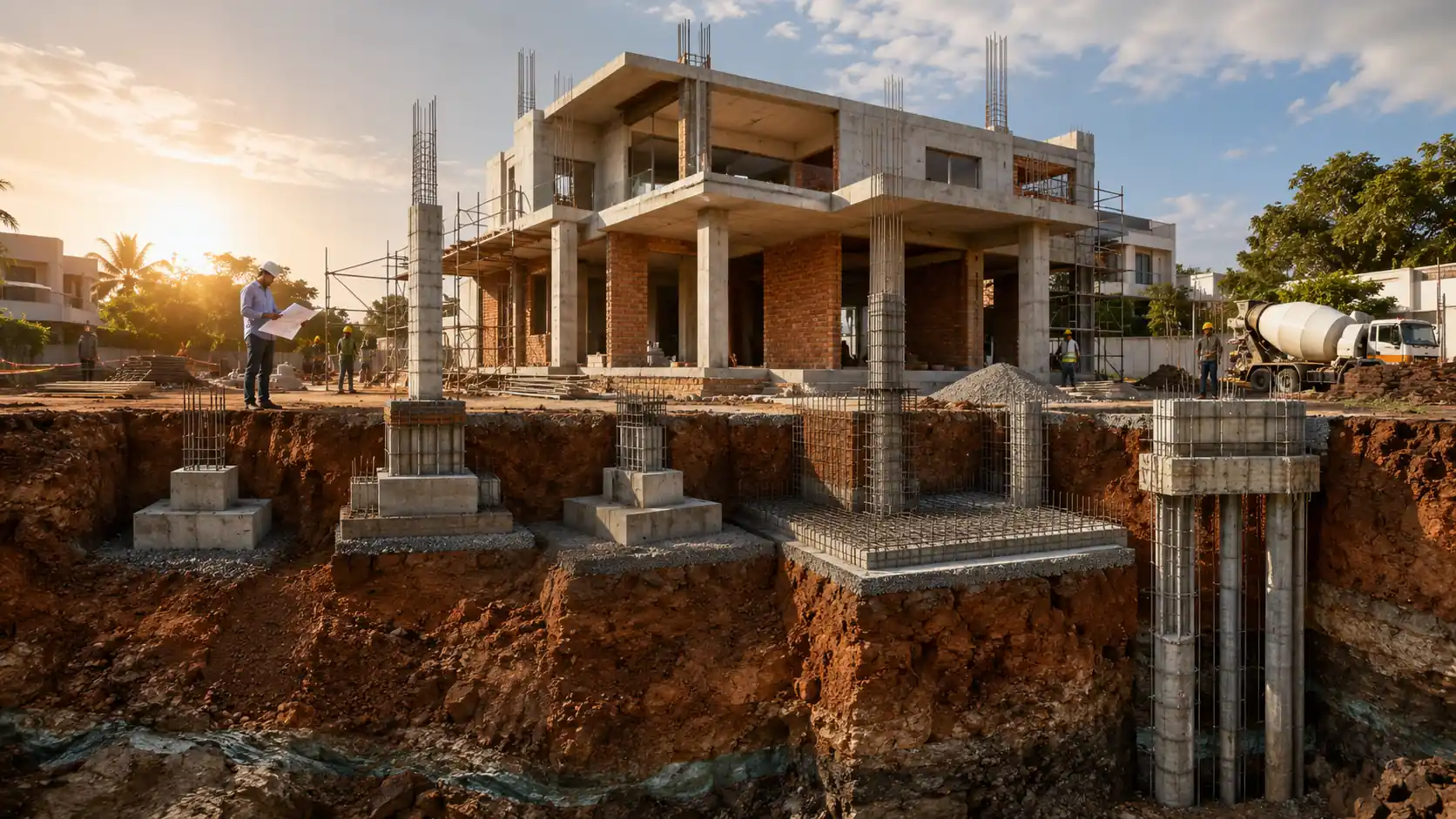
- Raft Foundation: Instead of individual footings under each column, the entire foundation becomes one continuous reinforced concrete slab. Standard practice in Velachery, parts of OMR, and Medavakkam. Distributes load evenly and prevents differential settlement.
- Pile Foundation: Concrete or steel piles are drilled or driven deep to reach load-bearing strata below weak surface soil. Required in Thoraipakkam, Pallikaranai, and any plot with SBC below 60 kN/m². Adds ₹4–10 lakhs to foundation cost depending on depth and pile count.
- Soil Stabilisation: Lime or cement is mixed into weak soil layers to chemically improve bearing capacity. Works well where soft clay is shallow and isolated. More cost-effective than a full pile design when conditions allow.
- Increased Footing Depth: Moving the foundation down to a more stable soil layer. Used when the top 1–2 metres are weak but competent strata exist below 3–4 metres — common in parts of Perambur and Kolathur.
- Load Reduction with AAC Blocks: When a raft is specified, switching partition walls from dense red brick to lightweight AAC blocks reduces dead load — with downstream benefits on beam and column sizing that can partially offset the foundation cost increase.
- Chemical Protection for Coastal Plots: In high-chloride coastal zones, the fix is: concrete upgraded to M25 or M30, epoxy-coated Fe 500 TMT bars replacing standard Fe 415, and waterproofing admixtures in the concrete mix. This costs roughly ₹80,000 more upfront on a standard home. It prevents ₹8–15 lakhs in structural repairs within a decade.
The bottom line: soil problems are engineering problems, and structural engineers solve them every day. The only situation with no good solution is building without knowing the problem existed. Our turnkey construction service handles every stage from soil investigation through to handover — so nothing falls through the gaps.
Got a soil test report and not sure what it means for your build? Our structural engineers can review it with you and explain your options clearly — no fee, no obligation.
Bring your report. We will help you understand what it means in plain language.When Should You Get Your Soil Test Done in Chennai — and How Long Will It Take?
Getting the timing right avoids delays, eliminates wasted design fees, and helps you hit Chennai's optimal construction window.
The Right Time to Commission a Soil Test
- 2–3 months before you plan to break ground: This gives your structural engineer time to complete foundation design, revise plans if the result surprises you, and move through CMDA plan approval without compressing your schedule. Read our CMDA plan approval guide to understand how long the approval process takes and how soil testing fits into that timeline.
- After plot registration, before your architect finalises any structural drawing: Soil results directly affect the structural design. Finishing the design first and testing the soil second risks expensive redesign — or worse, a variation order mid-construction.
- Optimal construction season in Chennai is January to March: Stable weather, low water tables, no monsoon interruption. Avoid starting foundation work during the Northeast Monsoon (October–December) in clay-heavy zones.
- Before you sign the sale deed, if the option exists: Experienced buyers increasingly commission a pre-purchase investigation and make their offer conditional on the results. This prevents buying land that will cost far more to build on than the price implied.
How Long the Process Takes, Day by Day
- Day 1: Lab team visits your site. Borehole locations are agreed. Drilling equipment is mobilised.
- Days 1–2: Boreholes are drilled to the required depth. SPT testing is conducted at every metre interval.
- Days 2–4: Soil samples go to the NABL-accredited laboratory for moisture, Atterberg, grain size, and chemical analysis.
- Days 5–7: Geotechnical engineer compiles the report, certifies the SBC value, signs and stamps in CMDA format. Report is delivered.
Total timeline: 5–7 working days for a standard plot. Complex sites, soft soil zones requiring deeper drilling, or coastal plots needing chemical testing can take 8–12 days. Some labs offer rush processing at additional cost.
Commission your soil test in November or December. That gives your structural engineer the report in hand before the January–March construction window opens. If CMDA approval runs slow, that buffer protects your build schedule — not your contractor's. See our building plan approval guide for a full timeline of the CMDA submission and approval process.
How HireandBuild Uses Soil Test Results — and Why It Changes the Way We Build
Across 400+ Chennai residential projects, HireandBuild has never treated soil testing as a box to tick. It is the first design input on every project — and it changes the structural outcome in ways that a contractor who skips it simply cannot account for.
When we are commissioned, our structural engineer reviews the soil investigation report before a single drawing is made. The SBC at the proposed foundation depth determines whether we specify isolated footings, a combined footing system, or a full raft. The N-value profile with depth tells us the exact footing depth — not a conservative guess based on habit, not a shortcut.
In Thoraipakkam, where we have worked on several infill plots, every single project has required pile foundations. The soft alluvial and reclaimed soil profiles leave no other viable option. Our geotechnical partners always drill to refusal or to at least 15 metres — whichever comes first — to find the actual load-bearing stratum, not assume it.
For coastal OMR plots, we commission chemical analysis on every project — even when clients do not ask for it. We have seen TMT bar corrosion begin within four years on coastal Chennai buildings where chemical testing was skipped and standard-grade materials were used. Specifying M25 concrete and Fe 500 epoxy-coated bars from the start adds roughly ₹80,000 to a standard home. It prevents ₹8–15 lakhs in structural remediation within ten years. Our house construction cost guide explains exactly how material upgrades like these affect overall project pricing.
One more thing we always tell homeowners: never accept a soil test from the same contractor who profits from a more complex foundation design. Commission your investigation independently from a NABL-accredited lab, get the report directly in your name, then share it with your structural engineer. That one step eliminates both over-engineering and under-engineering from the picture.
400+ Chennai homeowners have built with HireandBuild — each one starting with an honest soil investigation before any design began. If you are planning to build, that is the right place to start. View our full construction services or get an instant estimate with our free cost calculator.
Free quote · CMDA-compliant soil investigation included · No commitment required to talkFrequently Asked Questions About Soil Testing in Chennai
These are the exact questions Chennai homeowners ask before speaking to anyone — answered directly and completely.
Yes. For projects requiring CMDA building plan approval — which covers most multi-floor residential buildings in Chennai — a CMDA-approved soil investigation report is a mandatory document in the submission package. Even for projects outside CMDA enforcement zones, soil testing is strongly recommended: Chennai's highly variable geology makes it a structural safety requirement, not just a compliance formality. Skipping it can void your structural engineer's liability coverage and create problems during home loan documentation. Read our complete building plan approval guide to understand every document required for CMDA submission.
A standard CMDA-approved soil test (13–15M borehole depth with SPT and SBC analysis) costs ₹13,500–₹16,500 per borehole point from NABL-accredited labs in Chennai. Most residential plots require 2–3 test points, making the total ₹27,000–₹50,000 for a complete site picture. This is less than 0.5% of a typical Chennai construction budget — but it determines how 100% of the structural spend is allocated. See how soil testing fits into the full cost picture with our house construction cost guide and free cost calculator.
Thoraipakkam and Pallikaranai carry the highest risk — historically reclaimed marshland with SBC of just 60–100 kN/m² and elevated soil liquefaction risk during seismic events. Velachery and Medavakkam have expansive clay that swells significantly during monsoon and shrinks in summer, causing differential settlement. Coastal zones along OMR, Sholinganallur, and Perungudi have elevated chloride and sulfate levels requiring upgraded concrete and corrosion-resistant reinforcement. Chromepet, Pallavaram, and Tambaram have the most stable soil — red sandy or hard-rock formations with SBC above 160 kN/m².
SBC stands for Safe Bearing Capacity — the maximum load in kN/m² that the soil can support without shear failure or excessive settlement. For a standard G+1 residential building, a minimum SBC of 100–120 kN/m² at the proposed footing depth is generally acceptable for isolated footings. Values below 100 kN/m² require a raft or pile foundation system. Values above 150 kN/m² indicate good soil suitable for standard construction without special measures. Use our cost calculator to understand how different foundation systems affect your G+1 budget.
The SPT is conducted inside a borehole: a standard sampler is driven into the soil by a dropping hammer, and the number of blows needed to penetrate each 300mm is recorded as the N-value. CMDA requires SPT under BIS IS 2131 because it provides a reproducible, quantified measure of soil resistance at every metre of depth — the essential raw data for calculating SBC and responsibly sizing any foundation. Without N-values from SPT, foundation design is guesswork. See the full list of CMDA submission requirements in our building plan approval guide.
Yes, in almost every case. A poor soil test result changes your foundation design — it does not prevent you from building. Soft clay typically calls for a raft foundation; very low SBC or high water table zones require pile foundations (standard practice in Thoraipakkam and Pallikaranai). Soil stabilisation using lime or cement can improve shallow weak layers without a full pile design. Chemical protection measures handle coastal chloride and sulfate risks. The critical thing is knowing the soil condition before a single structural decision is made — not after. Our construction cost guide covers how each foundation type affects the overall project budget.
A standard residential soil investigation in Chennai takes 5–7 working days from site visit to CMDA-format report. Complex sites or coastal plots requiring chemical analysis may take 8–12 days. Commission your investigation immediately after plot registration and before your architect begins any structural drawings. The optimal construction window in Chennai is January to March — so commissioning in November or December gives your engineer time to design before the season opens, with buffer for any CMDA approval delays. See our building plan approval guide for a full project timeline from soil testing through to construction start.
Four questions — in this order: (1) Are you NABL-accredited? Ask for the certificate number and verify it yourself at nabl.gov.inOfficial. (2) Does your report format meet CMDA submission requirements — specifically NMT and SBC in the standard format? (3) Who signs the report — a qualified geotechnical engineer or just a lab technician? (4) Will you support my structural engineer with interpretation questions after the report is delivered? Our CMDA approval guide explains exactly what the report must contain to be accepted.
Isolated footings are individual concrete pads under each column — specified when SBC is above 150 kN/m² and soil is stable and consistent across the plot. A raft foundation is one continuous reinforced concrete slab beneath the entire building — specified when SBC is below 120 kN/m², when soil varies significantly across the plot, or when differential settlement risk is high. Your soil test report's SBC value at the proposed foundation depth is the primary factor your structural engineer uses to make this decision. Use our free cost calculator to see how each foundation type affects your budget.
Yes. HireandBuild commissions NABL-accredited, CMDA-compliant soil investigations as a mandatory first step on every project. The full report goes directly to you — the homeowner — and is used as the primary input for structural design. That means your foundation is engineered for what is actually under your specific plot, not built from a generic template applied to every site. Our turnkey construction package includes soil investigation, structural design, and CMDA plan submission at fully itemised pricing. Get an instant budget estimate using our free online cost calculator.
The Foundation Begins Before the Foundation
Soil testing is not a line item to cut. It is the first structural decision you make for a home that will carry your family for decades. In Chennai's geologically varied landscape — where expansive clay in Velachery sits 30 minutes from hard rock in Tambaram — knowing what is under your plot changes everything: your foundation type, your concrete grade, your reinforcement specification, your total construction budget, and the long-term safety of every beam and column above it.
The test costs ₹13,500–₹50,000 depending on depth and scope. A foundation failure costs ₹10–40 lakhs to remediate — if it is even fully repairable. There is no rational argument for skipping it. Use our complete construction cost guide to understand how every pre-construction decision — including soil testing — shapes your total budget. Or get a fast estimate right now with our free online cost calculator.
What we tell every homeowner who comes to us: great construction begins with honest data. And the most valuable data you can collect before a single drawing is made is the truth about the soil under your plot.
If you are planning to build in Chennai and want to start the right way, we are happy to talk — about your plot, your soil zone, and what makes sense for your project. Explore our full construction services or check your budget with our free cost calculator before we speak.
Free site assessment · CMDA-compliant soil investigation · No commitment to talk to us400+ residential projects completed across Chennai — from Anna Nagar to OMR, Tambaram to Thoraipakkam. Every project starts with honest soil data.