Which Aggregate is Best for House Construction in Chennai? (Size, Type & Cost Guide)
Most homeowners in Chennai spend weeks agonizing over floor tiles, paint colours, and kitchen layouts — but barely a day thinking about aggregate. That's a problem. Because if the aggregate going into your slab, columns, and foundation is wrong — wrong size, wrong quality, wrong source — no amount of beautiful tile work will save you from cracks appearing two years down the line.
Chennai's soil and climate create a very specific set of demands. The city sits on a mix of clay-heavy expansive soil in areas like Tambaram and Porur, rocky hard strata in Velachery and Pallavaram, and waterlogged zones near OMR and Sholinganallur. Add in Chennai's intense monsoon seasons, high humidity levels, and the occasional cyclone — and you have an environment where concrete quality, especially aggregate quality, determines how long your house actually stands.
Choosing the wrong aggregate can lead to concrete with low compressive strength, poor bonding, micro-cracks under load, and serious long-term durability issues. This is not a small decision. If you're planning to build a house in Chennai and want every structural decision made right the first time, our turnkey house construction service in Chennai covers material selection, mix design, and quality checks from Day 1.
What is Coarse Aggregate in Construction?
The role of aggregate goes far beyond just filling space:
- Transfers load through the concrete matrix, distributing weight across the structure
- Controls shrinkage — aggregate particles resist the natural shrinkage of cement paste as it cures
- Reduces cost — replacing expensive cement volume with aggregate makes concrete economically viable
- Controls workability — particle shape and size directly influence how easy the concrete is to pour and compact
In structural concrete used for house construction — slabs, beams, columns, foundations — the IS 383 standard (Bureau of Indian Standards) governs aggregate quality. Any aggregate used in Chennai residential construction should comply with this standard. If your contractor cannot confirm IS 383 compliance, that's a red flag.
Types of Coarse Aggregate Used in House Construction
Not all aggregates are equal. In Chennai, you'll encounter three main types, and the choice between them has a real impact on your structure.
1. Crushed Stone Aggregate (Blue Metal)
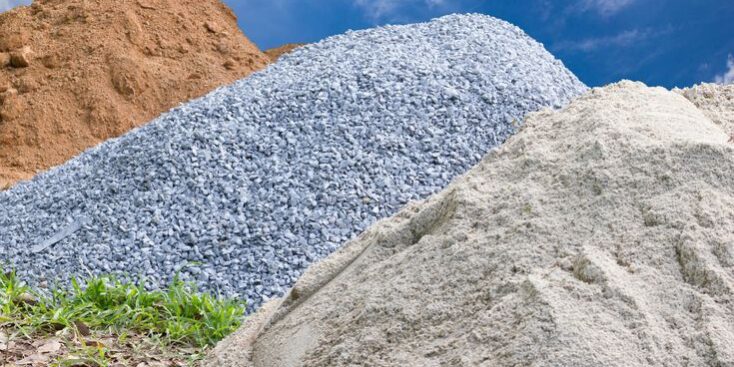
Best for: All Structural RCC WorkThis is the most commonly used aggregate for house construction in Chennai and across Tamil Nadu. It's produced by mechanically crushing granite rock in quarries, primarily sourced from areas like Kanchipuram, Thiruvallur, and Vellore districts. Locally known as "blue metal" (நீல மெட்டல்), this is what most reputable contractors specify for all RCC work.
Why it's the right choice for structural work:
- Angular shape creates strong mechanical interlocking between particles
- Rough surface texture improves bonding with cement paste
- High compressive strength — well-suited for columns, beams, and foundations
- Consistent grading achievable through screening at the quarry
Trade-off: The angular shape slightly reduces workability. Your contractor may need to adjust water content or use plasticizer admixtures for easy placement in congested reinforcement zones.
2. Gravel (River-Washed / Natural Aggregate)
Limited Use — Non-Structural OnlyNaturally rounded aggregate formed through river weathering. Once common in Chennai construction, river gravel is now increasingly restricted due to sand and gravel mining regulations in Tamil Nadu.
Characteristics:
- Smooth, rounded surface — excellent workability, easy to pour and compact
- Lower mechanical interlock — bonding strength with cement paste is inferior to crushed stone
- Variable quality — sourcing is inconsistent as river gravel isn't uniformly graded
For RCC structural elements in a house — slabs, columns, foundations — river gravel is not recommended as a primary aggregate in Chennai today. Use it only in non-structural applications like garden pathways or levelling fills.
3. Angular vs. Rounded Aggregate — Why Shape Matters
Key Decision FactorFor homeowners who want to make informed decisions on site, understanding the shape difference is essential:
| Property | Angular (Crushed Stone) | Rounded (River Gravel) |
|---|---|---|
| Bonding with cement | Excellent | Moderate |
| Workability | Lower (needs more water) | Higher (easy to pour) |
| Compressive strength | Higher | Lower |
| Best use | RCC columns, slabs, beams | Non-structural fills |
| Availability in Chennai | Readily available | Restricted / scarce |
| IS 383 compliance | Easily achieved | Variable |
Builder's verdict: For any load-bearing element in a Chennai house — stick with angular crushed stone (blue metal). The strength advantage is not marginal. It's structural.
Aggregate Sizes Explained (10mm, 20mm, 40mm)
This is where most homeowners and even some contractors make costly errors. Aggregate isn't a "one size fits all" material. The size you use must match the structural element being cast. Using the wrong size leads to voids, poor compaction, and concrete that doesn't achieve its design strength.
10mm Aggregate
Where it's used:
- Thin concrete sections — typically less than 75mm thick
- Plastering backing coats and precast concrete blocks
- Areas with heavy, closely spaced reinforcement where larger aggregate can't flow freely
- Rooftop waterproofing concrete bedding
In a typical Chennai house, you'll use 10mm aggregate for thin slab topping layers, certain precast elements, and situations where reinforcement congestion is high.
20mm Aggregate
This is the workhorse of residential construction in Chennai. If there's one size every homeowner should know, it's this one.
Where it's used:
- RCC slabs — ground floor, upper floors, and roof slab
- RCC columns and beams
- Footing and foundation concrete
- Staircase concrete and retaining walls
IS 456 (the Indian Standard for Plain and Reinforced Concrete) recommends that aggregate size should not exceed one-fourth the minimum dimension of the structural member. For standard residential construction in Chennai — where columns are typically 230mm × 300mm or larger and slabs are 125–150mm thick — 20mm aggregate satisfies this condition comfortably.
40mm Aggregate
Where it's used:
- Mass concrete fills — plinth filling and large foundation raft bases
- Road sub-base layers
- Under-slab lean concrete (PCC — Plain Cement Concrete) layers
- Large retaining wall sections
40mm is too coarse for slabs, columns, or beams in residential construction. It creates excessive voids, is difficult to compact around reinforcement, and produces weaker structural concrete if used incorrectly. However, it's economical for mass concrete where strength requirements are lower.
| Aggregate Size | Primary Use in Chennai House Construction |
|---|---|
| 10mm | Thin sections, congested reinforcement zones, precast elements |
| 20mm | RCC slabs, columns, beams, footings — standard structural use |
| 40mm | Mass concrete, PCC, large fills, sub-base layers |
Which Aggregate is Best for House Construction in Chennai
- Foundation and Footing: Use 20mm for RCC footings. If casting a large PCC base under the footing, 40mm is acceptable for cost efficiency — but the structural footing itself must be 20mm. In Chennai's expansive clay zones (Tambaram, Chromepet, Pallavaram), foundation concrete quality is non-negotiable.
- Columns and Beams: 20mm, without exception. Column concrete typically targets M20 or M25 grade in residential work. Angular 20mm aggregate with proper compaction gives you the interlocking strength that column concrete demands.
- Slabs: 20mm for RCC slabs. Some contractors in Chennai use a 10mm + 20mm blend for roof slabs to improve density and reduce voids — this is acceptable and can improve concrete quality with proper mix design.
- PCC / Flooring Base: 40mm is acceptable here for cost savings. This concrete is not load-bearing in the structural sense — it provides a level, firm base.
- Waterlogged zones (Sholinganallur, Perumbakkam, Kelambakkam): Specify aggregate with low water absorption (less than 2% by weight as per IS 383). High-absorption aggregate in waterlogged zones creates durability problems over time.
If you want expert guidance on how to optimize your entire construction material specification — not just aggregate — explore our house construction tips guide from builders who've worked across the city.
Role of Aggregate in Concrete Mix
A standard M20 concrete mix (commonly used for residential slabs in Chennai) uses a ratio of 1:1.5:3 — one part cement, 1.5 parts fine aggregate (M-sand), and 3 parts coarse aggregate by volume. This means coarse aggregate constitutes the largest volume component of the mix.
How Aggregate Affects Concrete Strength
The bond between aggregate particles and the surrounding cement paste — called the Interfacial Transition Zone (ITZ) — is where most concrete failures originate. Angular aggregate with a rough surface creates a stronger ITZ than smooth rounded aggregate. This is why crushed stone outperforms river gravel in structural concrete.
How Aggregate Affects Workability
More angular, rough aggregate requires more water to achieve the same workability as rounded aggregate. This is the workability-strength trade-off every builder manages. Adding too much water to compensate increases the water-cement ratio and dramatically reduces strength. The correct approach is to use a water-reducing admixture (superplasticizer), not excess water.
Aggregate-to-Cement Relationship
Using properly graded aggregate — a mix of particle sizes that pack efficiently — reduces void space in the mix, which means less cement paste is needed to fill those voids. This is both a cost optimization and a quality improvement: well-graded aggregate produces denser, more durable concrete.
Aggregate Cost in Chennai — 2026 Market Rates
Aggregate pricing in Chennai fluctuates based on source quarry, transport distance, market demand, and diesel rates. The rates below reflect current 2026 estimates — always get fresh quotes from your material supplier.
| Aggregate Type | Size | Approx. Cost (per cu. ft) | Approx. Cost (per ton) |
|---|---|---|---|
| Crushed Granite (Blue Metal) | 10mm | ₹55 – ₹70 | ₹850 – ₹1,100 |
| Crushed Granite (Blue Metal) | 20mm | ₹50 – ₹65 | ₹800 – ₹1,000 |
| Crushed Granite (Blue Metal) | 40mm | ₹40 – ₹55 | ₹650 – ₹850 |
| River Gravel | Mixed | ₹60 – ₹80 | ₹900 – ₹1,200 |
Factors that affect aggregate cost in Chennai:
- Distance from quarry: Quarries near Kanchipuram or Sriperumbudur supply Chennai efficiently. Building in far peripheral areas like Mahabalipuram or Gummidipoondi adds 10–15% to material cost.
- Order quantity: Large orders (10+ loads) typically attract a 5–8% discount from suppliers.
- Quality grade: IS 383 certified material from established suppliers costs slightly more than uncertified material — but it's the only material worth specifying for structural work.
- Seasonal demand: Aggregate prices in Chennai typically peak between January and April (peak construction season) and ease during the monsoon months.
- Diesel prices: Transport cost is directly linked to diesel rates. Price spikes in fuel translate quickly to aggregate delivery costs.
Common Mistakes When Choosing Aggregate
These are real mistakes that happen on real sites in Chennai. Each one costs money — either immediately in rework, or years later in repair bills.
- Using the wrong aggregate size for the structural element. The most common error is using 40mm aggregate for RCC slabs or columns to save money. The result is poor compaction, large voids, and concrete that fails to achieve its design strength. A slab designed for M20 concrete can end up performing at M10 or lower.
- Not checking for mud and clay content. Aggregate delivered in Chennai — especially from smaller, unregulated quarries — often has significant mud or clay coating on particles. IS 383 limits deleterious materials to 1% by weight for crushed stone. Simple field test: wash a handful in water. If it turns brown quickly, reject the load.
- Accepting flaky or elongated aggregate. Flaky particles don't compact well, create planes of weakness in the concrete matrix, and reduce strength. IS 2386 specifies maximum allowable flakiness index for structural aggregate — ask your supplier for this value.
- Storing aggregate directly on bare soil. Aggregate stacked on muddy ground absorbs fine soil particles into the mix. Always store on a clean, hard surface — compacted sand or a tarpaulin base. On a Chennai site during monsoon season, this matters enormously.
- Accepting mixed sizes in a single delivery. Some unscrupulous suppliers mix 10mm and 20mm aggregate together to clear stock. This produces inconsistent concrete. Insist on clearly segregated stockpiles for each aggregate size on your site.
- Ignoring water absorption in wet zones. In Chennai's coastal and low-lying areas, aggregate with high water absorption (above 2%) pulls water from the cement paste during casting, increasing the effective water-cement ratio and reducing strength. Always request water absorption data from your supplier.
Builder Tips — Practical Insights from the Ground
Quality Checking on Delivery
Every aggregate delivery should be visually inspected before unloading. Check for: excessive dust or mud coating (run the wash test), presence of flaky or elongated particles (more than 10–15% is unacceptable), presence of organic material like roots or soil lumps, and consistency of particle size with what was ordered.
For critical structural pours — foundation footings, ground floor columns, roof slab — insist on aggregate sieving on-site to verify gradation. This takes 15 minutes and can prevent a structural problem that takes 15 years to fully manifest.
Proper Site Storage
Storage rules to follow on every Chennai site:
- Store different aggregate sizes in separate, clearly labelled stockpiles
- Keep stockpiles on clean, hard ground — use polythene sheets during monsoon season
- Maintain at least 2 days of pour-quantity buffer so you're never forced to use freshly delivered, unwashed material
- Keep aggregate away from areas where cement bags are stored to prevent cross-contamination
Supplier Selection in Chennai
Choose aggregate suppliers who can provide: IS 383 test certificates for their material, delivery challans specifying size and quantity, and consistent delivery from the same quarry source throughout the project. Reputable quarry-direct suppliers in the Kanchipuram, Thiruvallur, and Chengalpattu districts are the standard source for Chennai construction.
When to Request an Independent Material Test
Invest in a third-party NABL-accredited lab test when:
- Your house is above 2,500 sq ft or G+2 or higher
- Your plot is in an unusual soil zone — waterlogged, coastal, or expansive clay
- You're sourcing from a new or unfamiliar supplier
Tests covering specific gravity, water absorption, impact value, and gradation cost approximately ₹3,000–5,000 and give you documented assurance of material quality. That's excellent value insurance against a structural problem.
Frequently Asked Questions
Which aggregate is best for house construction in Chennai?
For residential RCC construction in Chennai, 20mm angular crushed granite (blue metal) that is IS 383 compliant is the best choice. It provides strong mechanical interlocking, excellent bonding with cement paste, and is readily available from quarries in Kanchipuram and Thiruvallur.
What is the difference between 10mm, 20mm, and 40mm aggregate?
10mm aggregate is used for thin sections and congested reinforcement zones. 20mm is the standard size for RCC slabs, columns, beams, and footings in residential construction. 40mm is used for mass concrete, PCC layers, and large foundation fills, but should not be used for structural RCC elements.
What is coarse aggregate in concrete?
Coarse aggregate is granular material — typically crushed stone or gravel — with particle size greater than 4.75mm. It makes up 60–75% of the total volume of concrete and acts as the structural skeleton that transfers load and controls shrinkage.
What is the price of 20mm aggregate in Chennai in 2026?
As of 2026, 20mm crushed granite (blue metal) in Chennai costs approximately ₹50–65 per cubic foot, or ₹800–1,000 per ton. Prices vary based on quarry distance, order quantity, and seasonal demand.
Can river gravel be used instead of crushed stone for house construction?
River gravel is not recommended for structural RCC work in Chennai. Its rounded shape provides weaker bonding with cement paste compared to angular crushed stone, and Tamil Nadu's mining regulations have made river gravel scarce and inconsistent in quality. Use crushed granite (blue metal) for all structural elements.
How much aggregate is needed for a 1000 sq ft house in Chennai?
A standard 1,000 sq ft house in Chennai typically requires approximately 1,200–1,500 cubic feet of coarse aggregate across all structural elements — foundation, columns, beams, and slabs. Exact quantities depend on number of floors, foundation depth, and structural design.
What does IS 383 mean for aggregate?
IS 383 is the Bureau of Indian Standards specification that governs aggregate quality for concrete. It defines acceptable limits for particle size, grading, water absorption, deleterious materials, and physical properties. Any aggregate used in Chennai residential construction should comply with IS 383.
Ready to build your house in Chennai? Get material specs and structural quality managed by experts — not guesswork.
Explore Turnkey House Construction in Chennai Calculate Your Construction Cost — FreeBrought to you by HireandBuild — Chennai's trusted home construction partner.