Cost to Build a 1500 Sq Ft House in Chennai in 2026: The Honest All-In Guide
Planning to build a 1500 sq ft house in Chennai? Most guides hand you a rate per sq ft and stop. Almost none tell you what you will actually pay on handover day — and that gap is often ₹8–12 lakhs.
A 1500 sq ft house in Chennai in 2026 costs between ₹38 lakhs and ₹58 lakhs all-in, depending on your construction grade and plot location. The per sq ft rate ranges from ₹2,100 (basic) to ₹3,200 (premium) — but that number excludes approvals, compound wall, sump, borewell, and utilities, which together add ₹8–12 lakhs that most builder quotes do not show upfront.
Having completed over 500 residential projects across Chennai, we have seen too many homeowners hit budget shock halfway through construction. This guide is our attempt to change that.
By the end, you will know the real cost breakdown and what every approval costs. You will understand how location and soil type affect your budget — and exactly what to verify before signing with any builder.
Curious about your specific project cost?
Get a site-specific estimate from our engineers within 24 hours — no obligation. Or try our free cost calculator first.What Does It Cost to Build a 1500 Sq Ft House in Chennai in 2026?
Here is the full tier-wise breakdown — construction cost alone, then the honest all-in figure once approvals, utilities, and site infrastructure are included:
| Construction Grade | Rate per Sq Ft | Construction Cost (1500 sq ft) | Honest All-In Total |
|---|---|---|---|
| Basic | ₹2,100 – ₹2,300 | ₹31.5L – ₹34.5L | ₹38L – ₹43L |
| Standard | ₹2,400 – ₹2,700 | ₹36L – ₹40.5L | ₹44L – ₹50L |
| Premium | ₹2,800 – ₹3,200 | ₹42L – ₹48L | ₹51L – ₹58L |
The "all-in total" column includes CMDA or DTCP approval charges, soil test, borewell, sump, compound wall, TNEB electrical connection, and a basic modular kitchen. High-end interior design and landscaping are over and above this.
For a complete breakdown of how construction costs vary across different house sizes and configurations in Chennai, read our detailed house construction cost guide for Chennai.
Where Does Your Budget Actually Go? A Full Cost Breakdown
Understanding the split helps you make better trade-offs. For a standard build, here is approximately how every rupee is distributed across a project of this size:
| Cost Component | % of Total | Amount (Standard Grade) |
|---|---|---|
| Civil structure (RCC frame, columns, slab, brickwork) | 45–50% | ₹19L – ₹22L |
| Finishing (plastering, flooring, doors, windows, paint) | 25–30% | ₹11L – ₹13L |
| MEP (plumbing, electrical, sanitary) | 10–12% | ₹4.5L – ₹5.5L |
| Approvals, soil test, architect fees | 5–7% | ₹2.2L – ₹3.2L |
| Compound wall, main gate, sump, septic, borewell | 8–10% | ₹3.5L – ₹4.5L |
The civil structure is the non-negotiable part of your budget. This is where RCC frame construction, plinth beam casting, column sizing, and slab thickness are decided — and where cutting cost causes real long-term structural risk.
The finishing stage is where you have genuine flexibility. Swapping premium Italian tiles for good quality Kajaria vitrified tiles saves ₹1.5–2 lakhs with zero structural compromise.
In our projects, the most common budget overrun happens in the "approvals and add-ons" bucket. Most contractors quote only the construction rate and leave the rest for the homeowner to discover later — which is exactly the problem this guide is designed to prevent.
Basic, Standard, and Premium: What Is Actually Included?
Most builders use these three tiers but define them differently. Here is what each tier realistically means in Chennai's 2026 market:
| Feature | Basic Package | Standard Package | Premium Package |
|---|---|---|---|
| Cement | OPC 43 grade (local brands) | UltraTech or Coromandel 53 grade | UltraTech 53 grade / specialty blends |
| Steel | Fe 500 TMT (local mill) | Tata Tiscon / JSW Fe 500D | Tata Tiscon Fe 550D |
| Bricks / Blocks | 2nd class clay bricks | 1st class chamber bricks | AAC blocks (lightweight, better thermal) |
| Sand | River sand or basic M-sand | Double-wash M-sand | Double-wash M-sand |
| Flooring | 2×2 ft ceramic tiles | Kajaria vitrified 2×2 ft | Imported or large-format tiles |
| Doors | PVC bathrooms, flush doors rooms | Teak frame + panel doors for bedrooms | Solid teak main door, premium throughout |
| Windows | Aluminium sliding | UPVC sliding | UPVC with mesh and grills |
| Waterproofing | Basic cement-based coat | Dr. Fixit or Fosroc membrane | Full waterproofing membrane system |
| Painting | Tractor emulsion (2 coats) | Asian Paints Royale or equivalent | Luxury emulsion with textured finish |
The difference between basic and standard is not cosmetic — it is structural. AAC blocks in a premium build reduce wall load on the RCC frame and provide better insulation against Chennai's heat. We always recommend standard grade as the minimum for a home you plan to live in for 25 or more years.
Is a G+1 Duplex Cheaper Than Building the Same Area on a Single Floor?
A G+1 duplex for 1500 sq ft built-up area costs 8–12% more than a single-storey build of the same total area — roughly ₹3.5–5 lakhs extra in structural cost. But a duplex lets you build on a smaller plot, which typically saves ₹8–15 lakhs in land cost in Chennai's current market. The math usually favours the duplex.
The added structural cost comes from three things: a staircase, a first-floor slab that acts as the ground floor ceiling, and stronger columns designed for additional load. These are not optional — they are what makes a two-storey structure safe.
To build a single-floor house comfortably, you need at least a 1,800–2,000 sq ft plot. In Chennai suburbs, a plot that size now costs ₹30–60 lakhs depending on location. Splitting across two floors lets you build on a 30×40 or 30×45 plot — saving ₹8–15 lakhs on land while adding only ₹4–5 lakhs in structural cost.
A single-floor house makes more sense when you are building for elderly family members who need accessibility, when the plot is already large and paid for, or when the design involves a large open courtyard that a second floor would compromise.
Does Construction Cost Vary by Area in Chennai?
Yes — meaningfully. Construction cost for the same project varies by location for three reasons: soil type, material logistics, and local labour rates. Here is the area-by-area breakdown that most builders do not publish:
| Chennai Area | Typical Soil | Foundation Cost Impact | Rate vs City Average | Notes |
|---|---|---|---|---|
| Anna Nagar / T. Nagar | Firm alluvial / hard | Neutral | +5 to +8% | Premium zone; higher labour cost |
| Velachery / Pallikaranai | Soft, waterlogged zones common | +₹1–1.5L (pile or raft possible) | +3 to +6% | Waterproofing needs extra attention |
| Tambaram / Guduvanchery | Firm red soil, good bearing | Neutral to lower | Standard | Excellent soil; good value zone |
| Avadi / Ambattur | Mixed — check plot-specific | Neutral | −3 to −5% | Lower labour rates; good budget zone |
| OMR / ECR | Coastal sandy, low bearing in spots | +₹1–2L in sandy zones | +2 to +4% | Soil test non-negotiable here |
| Sriperumbudur / Perungalathur | Firm, semi-urban | Lower | −5 to −8% | Best budget zone; slightly longer commute |
The single most important takeaway: always do a soil test before finalising your foundation design. In Velachery or parts of OMR where the soil bearing capacity is low, a standard isolated footing may need to be upgraded to a combined footing or even pile foundation. That can add ₹1–2 lakhs to your civil cost with zero warning if you skipped the test.
Soil tests in Chennai cost ₹4,000–8,000 and save multiples of that figure in avoided surprises.
What Hidden Charges Is Your Builder's Quote Missing?
Picture this. You have bought a plot in Tambaram. Your budget is ₹45 lakhs. You go with the lowest of three quotes. Six months in, the bills are already past ₹40 lakhs and you are not yet at the finishing stage. What happened?
Here is what most builders do not include in their per sq ft rate — and what we lay out in full before you sign anything:
- Soil test (₹5,000–8,000): Mandatory before foundation design. Skipping it is how foundation costs surprise you midway through excavation.
- Building plan approval — CMDA/DTCP/Panchayat (₹40,000–1.5 lakhs): Varies by zone and built-up area. Detailed in the section below.
- Architect and structural engineer fees (₹50,000–1.5 lakhs): Structural drawings certified by a licensed engineer are legally required for CMDA approval.
- Sump construction (₹80,000–1.5 lakhs): A 6,000–10,000 litre underground sump is standard for a project of this size. Almost never included in the base construction rate.
- Borewell and pump (₹60,000–1.2 lakhs): Depth varies dramatically by area — 150 feet in Tambaram, 400+ feet in parts of OMR. Get a local quote before budgeting this.
- Compound wall and main gate (₹1.5–3 lakhs): For a 30×60 plot, a standard compound wall with a fabricated gate runs ₹1.8–2.5 lakhs. Decorative gates cost more.
- TNEB electrical connection and EB deposit (₹40,000–80,000): New service connection charges, EB deposit, and internal wiring from the meter to main DB are separate from the construction package.
- Septic tank (₹60,000–1 lakh): Required where CMDA underground drainage is not available — which includes most suburban plots in Tambaram, Avadi, and Sriperumbudur.
Add these up at standard rates and you are looking at ₹6–10 lakhs that a ₹2,400/sq ft quote simply does not contain.
At HireandBuild, your BOQ is fully itemised before you sign anything.
Every charge listed above is disclosed upfront — no surprises at handover.Do You Need CMDA or DTCP Approval — and What Does It Cost?
Your plot's location determines the authority. Plots within Chennai's metropolitan zone require CMDA (Chennai Metropolitan Development Authority) approval. Plots in suburban and peri-urban areas — Guduvanchery, Sriperumbudur, outer OMR — typically require DTCP approval. Village panchayat areas have their own simpler permit process.
Approximate approval costs for a 1500 sq ft residential house:
- CMDA approval fee: ₹35–70 per sq ft of built-up area (slab-based; varies by zone and floor count). For this built-up size, expect ₹52,000–1,05,000 in government fees alone, plus facilitation.
- DTCP approval: ₹20,000–55,000 in fees for a standard residential plot.
- Panchayat permit: ₹8,000–25,000 — but verify whether your panchayat area has been recently merged into a municipality or corporation.
Timeline: CMDA approval typically takes 30–60 days if documents are complete. DTCP can take 20–45 days. Common delays happen when the encumbrance certificate, property tax receipt, or structural drawing has discrepancies.
Documents generally required: Sale deed and patta of the plot, property tax receipt, FMB (field measurement book) sketch, structural drawings certified by a licensed structural engineer, and an application form with site photographs.
Note: Building without the appropriate approval carries significant risk — including demolition orders, inability to get a TNEB connection, and difficulty reselling the property. HireandBuild handles the complete CMDA and DTCP approval process as part of every turnkey project.
What Did a Real 1500 Sq Ft House in Tambaram Actually Cost in 2025?
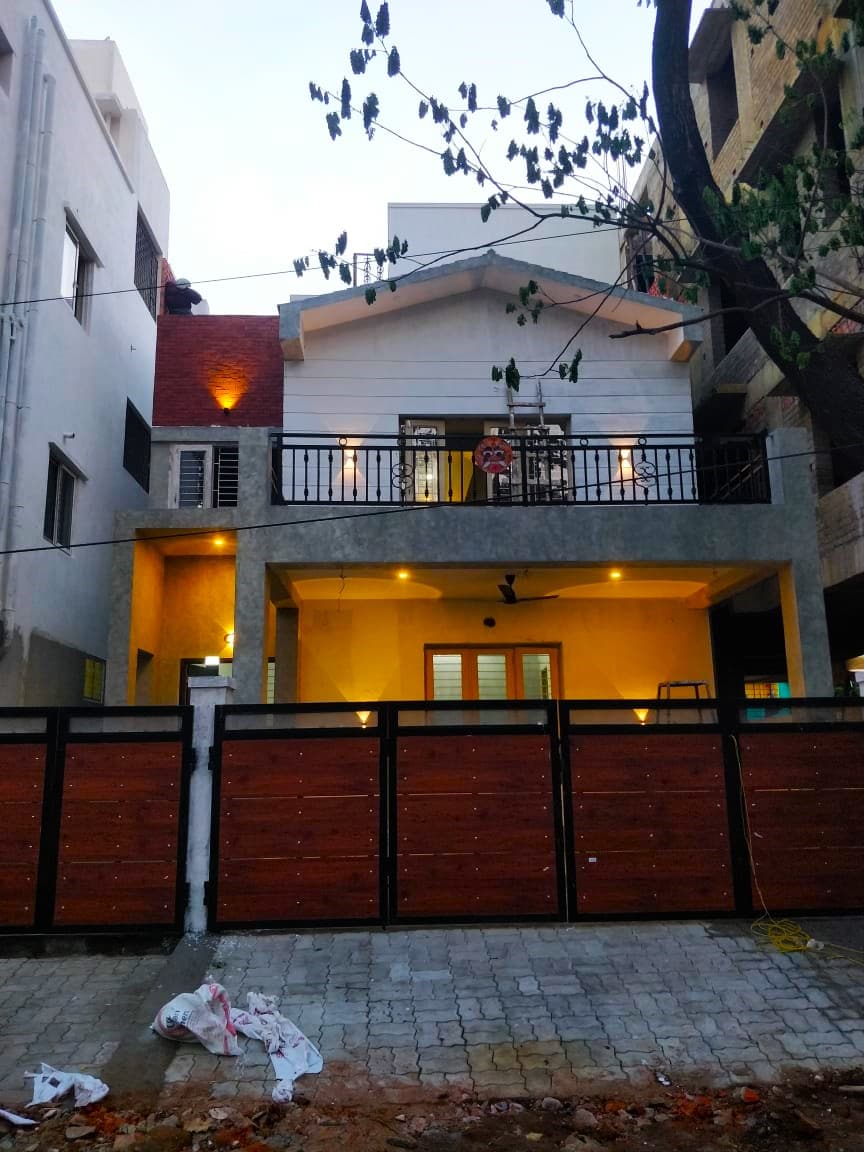
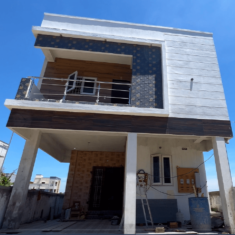
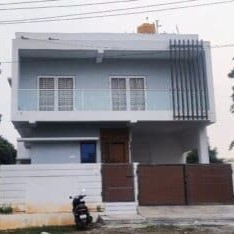
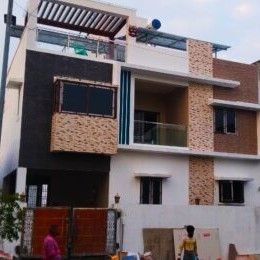
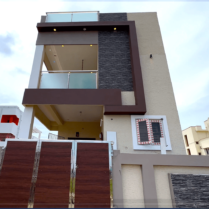
This is a real HireandBuild project completed in late 2025 — a 3-bedroom G+1 duplex in Tambaram West, on a 30×50 plot.
Material Specification Used
- Cement: UltraTech 53 grade OPC
- Steel: Tata Tiscon Fe 500D TMT bars
- Bricks: 1st class chamber bricks (9-inch external walls, 4.5-inch internal)
- Sand: Double-wash M-sand from Hosur quarries (river sand unavailable without significant premium)
- Flooring: Kajaria vitrified 800×800 mm for living/dining; 600×600 mm for bedrooms
- Doors: Teak frame with shutter for main door; sal wood frame + flush door for bedrooms; PVC for bathrooms
- Windows: UPVC sliding with mesh
- Plumbing: Finolex CPVC pipes; Parryware sanitary fittings
- Waterproofing: Dr. Fixit crystalline for terrace slab; Fosroc for basement and sump
Final Itemised Cost
| Item | Amount |
|---|---|
| DTCP approval and architect fees | ₹85,000 |
| Soil test | ₹6,000 |
| Civil structure (RCC frame, columns, slabs, brickwork) | ₹18,40,000 |
| Finishing (plastering, tiling, doors, windows, painting) | ₹9,80,000 |
| MEP (plumbing, electrical, sanitary) | ₹4,20,000 |
| Staircase, grills, fabrication | ₹1,10,000 |
| Waterproofing (terrace + sump) | ₹75,000 |
| Sump (8,000 litres) | ₹1,15,000 |
| Septic tank (6,000 litres) | ₹78,000 |
| Borewell (210 ft) + pump | ₹92,000 |
| Compound wall + main gate | ₹1,85,000 |
| TNEB connection + EB deposit | ₹52,000 |
| Grand Total | ₹40,38,000 |
Construction cost per sq ft (excluding approvals, sump, borewell, compound wall): ₹2,270
All-in cost per sq ft including everything: ₹2,692
We built this. We can build yours. See our full portfolio of completed Chennai homes for more project walkthroughs with itemised costs.
How to Plan, Build, and Save Without Budget Shock
Which Materials Should You Specify — and Where Can You Safely Save?
Chennai's climate is demanding on buildings. You have high humidity for most of the year, two monsoon seasons, salt-laden coastal air in seafront zones, and expansive clay soil in certain pockets. These conditions should directly influence your material choices.
Where you should not cut cost:
Steel grade matters more than most homeowners realise. The difference between Fe 500 and BIS-standard Fe 550D TMT bars is roughly ₹25,000–40,000 for a total project. For a structure you plan to live in for 30 years, this is one of the worst trade-offs to make. Specify 53 grade OPC from UltraTech or Coromandel for all structural work — the ₹3–5 per bag saving on 43 grade OPC is not worth it in columns and beams.
Waterproofing is the other non-negotiable. Chennai's northeast monsoon (October–December) is intense and prolonged. A terrace slab without a proper Dr. Fixit or Fosroc crystalline waterproofing system will begin showing seepage within 2–3 years. Proper waterproofing costs ₹60,000–90,000 and saves ₹3–5 lakhs in repair work over a decade.
Where you can save without regret:
Interior flooring is the most flexible budget lever. Good quality Kajaria or Somany vitrified tiles at ₹45–65 per sq ft deliver excellent durability. Imported tiles at ₹150–300 per sq ft are entirely an aesthetic choice. On 1500 sq ft of flooring area, that is a ₹1.5–3.5 lakh difference for visual preference alone.
AAC (autoclaved aerated concrete) blocks cost 15–20% more than 1st class clay bricks but reduce your wall load, improve thermal insulation, and accelerate brickwork by 20–25%. The upgrade costs approximately ₹50,000–80,000 and pays back in lower AC bills and a faster construction timeline.
How Long Does Construction Take, Stage by Stage?
A standard build of this size in Chennai takes 9–14 months from soil test to handover. The range is wide because government approval and monsoon scheduling introduce genuine variability.
Soil test, plan drawing, CMDA/DTCP approval, site survey.
Excavation, PCC layer, footing casting, curing.
Plinth beam, anti-termite treatment, backfill, PCC floor.
Column casting, brickwork, lintel beams, slab shuttering and pour.
Repeat of ground floor work plus staircase casting.
Terrace slab, overhead tank, waterproofing layer, curing.
Internal and external plastering, door and window frames.
Plumbing, electrical conduit laying, drain lines, sump, septic.
Flooring, tiling, painting, door shutters, fittings, electrical fit-out.
Final inspection, snag list, TNEB connection, borewell commissioning.
The two biggest delay drivers in Chennai are CMDA/DTCP approval (which can stretch to 3–4 months if documents have discrepancies) and the northeast monsoon (October–December), which affects concrete curing quality and material delivery. We always share a monsoon-adjusted construction schedule with our clients before work begins.
Practical Ways to Reduce Cost Without Cutting Corners
In our experience, a well-planned project can be built for 10–15% less than an unplanned one — without any reduction in quality. The savings come from decisions made before the first brick is laid, not from substituting cheaper materials later.
- Fix your material specification list before getting quotes. When you ask three contractors to quote on vague "standard construction," you get three numbers with three different assumptions. Hand them a specific material spec sheet and you are comparing the same product — the price gap tightens dramatically.
- Design for efficiency, not just aesthetics. Every cantilever, curved wall, and irregular column spacing adds structural cost. A compact rectangular floor plan costs 8–12% less to build per sq ft than an elaborate one of the same area.
- Schedule your slab pours outside monsoon season. Concrete poured during rain requires longer curing and sometimes repeat work. Keep all major structural pours between January and May where your timeline allows.
- Source M-sand over river sand. River sand prices in Chennai are volatile and supply is legally restricted. Double-wash M-sand from Hosur or local quarries is consistent in quality and currently ₹15–25 per cubic foot cheaper in most Chennai markets.
- Consolidate MEP work under one contractor. Splitting plumbing and electrical to different sub-contractors creates coordination gaps that cost time and money. A turnkey builder handling both under a single point of responsibility typically delivers MEP work 15–20% faster.
- Agree on a milestone-based payment schedule. Never pay more than 10–15% upfront. Tie each payment to a clear, verifiable construction milestone — this protects your cash flow, keeps the contractor accountable, and reduces the risk of fund diversion.
Labour Contract or Turnkey Builder: Which Is Right for You?
In a labour contract model, you buy all materials directly and hire a contractor only for labour. This can save 8–12% on total construction cost in theory — but it requires you to manage material procurement, quality checks, delivery scheduling, vendor negotiations, and daily site supervision yourself.
In a turnkey construction model, one company handles design, approvals, materials, labour, and quality from foundation to handover. You have a single point of contact, a fixed quote, and milestone-based payments.
For a Chennai homeowner who is employed, lives at a distance from the site, or does not have prior construction experience, the turnkey model almost always delivers better total value. Over 14 years, we have been called in to audit or repair dozens of labour-contract houses where saving ₹3 lakhs on paper cost ₹8 lakhs in remediation. Material pilferage, poor quality mortar mixing, and understrength concrete are daily risks on a self-managed site.
The labour contract makes sense if you have a trusted, experienced PMC already engaged, live near the site, or are in the construction industry yourself.
Ready to Start Your Build?
Join over 500 Chennai homeowners who built with HireandBuild. Get a no-surprises estimate that covers every line item — from soil test to TNEB connection. Our engineers will walk you through it before any work begins.
Book Your Free Site Visit →Frequently Asked Questions (FAQs)
Expect to pay ₹38 lakhs to ₹58 lakhs all-in, depending on construction grade and location. The per sq ft rate runs from ₹2,100 (basic) to ₹3,200 (premium). The honest all-in figure adds ₹6–12 lakhs for approvals, compound wall, sump, borewell, and utilities that most builder quotes exclude. Always ask for a full BOQ before comparing quotes.
Expect 9–14 months from soil test to handover. The biggest variables are CMDA or DTCP approval time (6–10 weeks if documents are complete) and whether your structural slab work falls during the northeast monsoon (October–December), which typically adds 3–6 weeks. At HireandBuild, we provide a phase-by-phase schedule before any work begins.
Construction cost per sq ft in Chennai in 2026 ranges from ₹2,100 (basic) to ₹3,200 (premium). Standard grade — our recommended minimum for a long-term residence — sits at ₹2,400–2,700 per sq ft. This covers civil structure, finishing, and basic MEP but typically excludes approvals, compound wall, sump, borewell, and TNEB connection.
Yes, meaningfully. Central zones like Anna Nagar and T. Nagar run 5–8% above city average due to higher labour rates. Suburban zones like Tambaram and Guduvanchery offer standard rates with excellent soil conditions. Coastal zones in parts of OMR and ECR can see foundation cost additions of ₹1–2 lakhs where soil bearing capacity is low. A soil test before finalising foundation design is non-negotiable in any zone.
A G+1 duplex costs 8–12% more in structural cost — roughly ₹3.5–5 lakhs extra for the staircase, first-floor slab, and stronger column design. However, a duplex lets you build on a smaller plot, which in Chennai’s land market typically saves ₹8–15 lakhs. For most families building on a 30×40 or 30×45 plot, the duplex delivers better total value.
It depends on your plot’s location. Plots within Chennai’s metropolitan zone require CMDA approval. Suburban plots — Guduvanchery, Sriperumbudur, outer OMR — typically require DTCP approval. Village panchayat areas have their own permit process. Building without the correct approval risks demolition orders, TNEB connection refusal, and resale complications. HireandBuild handles the full approval process on every turnkey project.
Built-up area is the total area covered by the external walls of your house, including wall thickness, staircase, and any common spaces. Carpet area is the actual usable floor space inside the walls. In a typical Chennai residential house, carpet area is approximately 85–88% of built-up area. Construction cost per sq ft is always quoted on built-up area, so a 1500 sq ft built-up house gives you roughly 1,275–1,320 sq ft of actual living space.
Check the builder’s registration on Tamil Nadu RERA at tnrera.in. Before signing, request a complete BOQ — not just a rate per sq ft. Confirm structural drawings are certified by a licensed engineer. Visit at least two recently completed projects and speak with past clients directly. Insist on milestone-based payments tied to verifiable construction stages — this protects your cash and keeps the builder accountable.