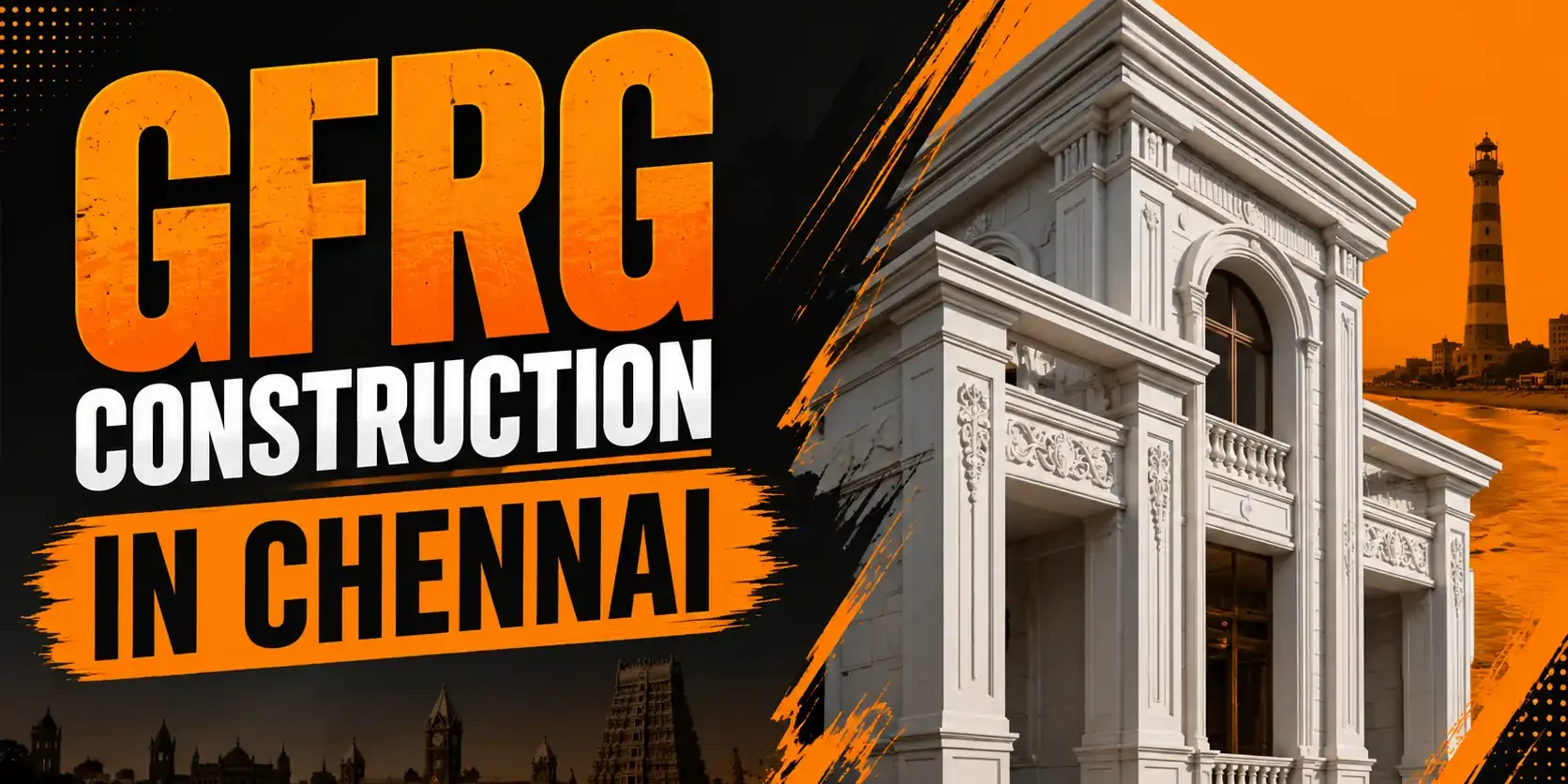
GFRG Construction in Chennai – Is It Worth It? (Complete 2026 Guide)
GFRG construction promises faster builds and lower costs. But for Chennai homeowners, the real question is whether your plot qualifies — and whether the savings survive after you add crane rental, skilled labour, and foundation work. Having delivered 250+ residential projects across Chennai, we've had this exact conversation with hundreds of families. This guide gives you the honest picture most contractors won't.
GFRG (Glass Fibre Reinforced Gypsum) construction in Chennai costs ₹1,400–₹1,900 per sqft all-in (2026), including foundation, panel erection, RCC filling, and finishes. It is 20–30% faster than conventional RCC brick construction and is approved by BMTPC and IIT Madras. However, it requires road access of at least 25 feet for crane movement — disqualifying many inner-city Chennai plots.
- All-in cost (2026): ₹1,400–₹1,900/sqft. See our complete house construction cost guide →
- Build time (G+1): 6–9 months vs 12–16 months for conventional RCC
- Minimum road width: 25 feet for crane access — hard requirement
- CMDA approval: Same process as RCC — structural engineer certificate required
- Who should NOT use GFRG: Narrow roads, custom layouts, phased builds, coastal plots without good waterproofing
- Bank loans: Available but requires BMTPC certification and additional documentation
- Certifications: IIT Madras tested, BMTPC approved Official
In this guide, you'll learn exactly what GFRG costs in Chennai, whether your plot is suitable, how it compares to conventional RCC, the real disadvantages no one talks about — and the honest answer to whether it's right for you.
Not sure if GFRG suits your Chennai plot? Our engineers assess your site and give you an honest recommendation — free, no obligation.
Plot access check · Cost comparison · 24-hour responseWhat Exactly Is GFRG Construction — And How Is It Different from RCC?
GFRG stands for Glass Fibre Reinforced Gypsum. It is a prefabricated panel-based construction technology originally developed in Australia — also marketed as Rapidwall — and brought to India through research at IIT Madras. Large hollow gypsum panels (12m × 3m), reinforced with glass fibre rovings, are factory-manufactured and transported to site. A crane erects them upright. Starter bars cast into the plinth beam anchor each panel. The hollow cellular cavities are then filled with concrete and TMT bar reinforcement, creating load-bearing structural walls.
The technology holds strong credentials. IIT Madras's Civil Engineering Department has certified GFRG's structural performance, and the Building Materials and Technology Promotion Council (BMTPC) Official — a Government of India body — has approved the system under its quality certification framework. BIS standards govern the RC fill design inside the cavities. BACE India and FRBL are the primary manufacturers currently supplying Tamil Nadu.
Unlike conventional construction — where workers lay brick by brick and cure mortar over weeks — GFRG panels arrive ready to erect. The panels are load-bearing, so in standard designs you eliminate the traditional RCC frame entirely. A G+1 house that takes 12–16 months in brick and RCC can be completed in 6–9 months with GFRG. That time saving is real. But it comes with real constraints too.
How the GFRG Construction Process Works — Step by Step
- Foundation and plinth beam: Standard footing and plinth beam construction — same as conventional RCC. Starter bars are cast into the plinth at panel grid locations.
- Panel delivery: Factory-manufactured GFRG panels (typically 12m × 3m, ~40kg/m²) arrive by flatbed truck and are staged at the boundary.
- Crane erection: A mobile crane lifts and positions each panel onto the starter bars. The crane must move freely — requiring 25ft+ road width with no overhead obstruction.
- Locking and bracing: Adjacent panels are connected via a locking system at vertical joints. Temporary bracing holds panels plumb during filling.
- RC filling: The hollow cellular cavities are filled with concrete (minimum M20) and vertical TMT bar reinforcement. This creates the structural shear wall system.
- Roofing slab and finishes: A standard RCC slab is cast over the panel structure. Plumbing, electrical, flooring, and finishes proceed as normal.
GFRG vs Conventional RCC Brick Construction — Key Differences
| Parameter | GFRG Construction | Conventional RCC + Brick |
|---|---|---|
| Structural System | Load-bearing gypsum panels + RC fill | RCC frame + masonry infill |
| Build Time (G+1) | 6–9 months | 12–16 months |
| All-in Cost (Chennai, 2026) | ₹1,400–₹1,900/sqft | ₹1,899–₹2,500/sqft |
| Wall Weight | ~40% lighter than brick | Heavier; more load on foundation |
| Earthquake Resistance | High — IIT Madras tested, shear wall behaviour | Good — depends on structural design |
| Design Flexibility | Limited — panels are fixed dimensions | High — fully customisable layouts |
| Skilled Labour | Specialist erection crew required | Widely available in Chennai |
| Road Access Needed | 25ft+ for crane — hard requirement | No minimum road width |
| Eco-Friendliness | Recycled industrial gypsum; low embodied energy | Higher embodied energy (cement, burnt bricks) |
| Bank Loan Eligibility | Available with extra documentation | Standard — no issues |
| Phased Construction | Difficult — requires crane re-mobilisation | Easy — add a floor anytime |
| Cost ranges are all-in estimates including foundation, structure, MEP, and basic finishes. Actual cost depends on plot location, floor count, and finish level. | ||
What Does GFRG Construction Actually Cost in Chennai in 2026?
Here is the number most GFRG contractors don't show you upfront: the all-in cost. Many quotes cite ₹1,200/sqft for panel-and-erection work only. But when you add foundation, crane rental (typically ₹80,000–₹1.5 lakhs), specialist labour, M-sand and TMT bar for RC filling, and finishes, the realistic total lands between ₹1,400–₹1,900/sqft. That is still competitive versus conventional construction — but the gap is narrower than the brochures suggest.
Here is a full component-by-component breakdown for a typical Chennai GFRG project.
| Cost Component | Budget Package | Standard Package | Premium Package |
|---|---|---|---|
| Foundation (Footing + Plinth Beam) | ₹180–₹220/sqft | ₹200–₹250/sqft | ₹240–₹290/sqft |
| GFRG Panel Supply | ₹280–₹330/sqft | ₹300–₹350/sqft | ₹320–₹370/sqft |
| Crane Erection + Specialist Labour | ₹120–₹150/sqft | ₹140–₹170/sqft | ₹150–₹180/sqft |
| RC Filling (Concrete + TMT) | ₹150–₹180/sqft | ₹170–₹200/sqft | ₹190–₹220/sqft |
| Roofing Slab | ₹120–₹150/sqft | ₹140–₹165/sqft | ₹160–₹200/sqft |
| Plumbing + Electrical | ₹150–₹180/sqft | ₹180–₹220/sqft | ₹220–₹280/sqft |
| Flooring + Waterproofing + Finishes | ₹200–₹250/sqft | ₹250–₹350/sqft | ₹400–₹600/sqft |
| Total Estimated Cost | ₹1,200–₹1,460/sqft | ₹1,380–₹1,705/sqft | ₹1,680–₹2,140/sqft |
| In our experience, most Chennai homeowners building 1,500–2,000 sqft land in the Standard package range. Budget package is realistic only with good crane access and basic finishes. See our full cost guide for conventional RCC comparisons. | |||
Want to know exactly what your GFRG project would cost? Our engineers give you a line-by-line estimate within 48 hours — no obligation. Use our free cost calculator for a quick estimate.
No commitment required to get a number.Is Your Chennai Plot Suitable for GFRG Construction?
This is the most important question to answer before you get excited about speed and cost. We've seen homeowners in Velachery, Avadi, and Medavakkam spend weeks researching GFRG only to discover their street is 18 feet wide — making crane access impossible. Run through this checklist before anything else.
GFRG Site Feasibility Checklist
- Road width ≥ 25 feet adjacent to the plot — The crane truck needs to park, set up, and swing the boom freely. Below 25 feet is high-risk; below 20 feet is a hard disqualifier.
- No overhead power cables obstructing crane swing — TANGEDCO lines running across your frontage require temporary disconnection — adding cost and 2–4 weeks of delay. The crane boom typically exceeds 12–15 metres height.
- Soil bearing capacity ≥ 10 tonnes per sqm at crane outrigger positions — Sandy or filled land in parts of Kelambakkam and the Sholinganallur coastal stretch may need soil improvement. Commission a soil investigation before finalising GFRG — read our guide to soil testing in Chennai.
- No underground drainage culvert directly in front of the plot — Crane stabiliser outrigger pads need firm, uninterrupted ground. Check CMWSSB maps for underground mains near your boundary.
- Plot area ≥ 600 sqft built-up — At 12m × 3m per panel, very small plots under 400 sqft site area generate excessive panel wastage, eliminating the cost advantage over conventional construction.
- CMDA/DTCP zone allows residential construction — Verify the plot is not in a no-construction zone, flood-prone CRZ area, or under any court stay. Read our CMDA building plan approval guide for zone verification steps.
- No significant underground utilities in the crane outrigger zone — Check CMWSSB maps for water board mains near your property boundary before any crane positioning.
A family in Porur bought a 2,400 sqft plot, budgeted ₹55 lakhs, and committed to GFRG after reading about the speed benefits. Their road was 22 feet wide. The GFRG contractor said "it'll be fine" verbally. On crane mobilisation day, the crane couldn't stabilise safely on the narrow road. They lost two months and had to switch back to conventional RCC, paying two sets of contractor mobilisation costs. The takeaway: get a physical site feasibility check — not just a verbal okay — before signing any GFRG contract. HireAndBuild does this assessment free of charge before any agreement is signed.
What Are the Real Advantages of GFRG Construction in Chennai?
When the site suits it, GFRG delivers genuine benefits — not just marketing claims. Here is what holds up in real Chennai projects:
How Much Time Does GFRG Actually Save on a Chennai Build?
Panel erection for a full G+1 house typically completes in 4–8 weeks, compared to 4–6 months of brickwork in conventional construction. For a homeowner paying rent while building, this saving alone can offset ₹1.5–3 lakhs in rental costs. CMDA approval timelines (typically 1–2 months) remain the same regardless of construction method and run in parallel with site preparation.
- Faster construction timeline — A G+1 house that takes 12–16 months in conventional RCC is typically complete in 6–9 months with GFRG. The panel erection phase alone accounts for most of this saving.
- Lighter dead load on foundation — GFRG walls weigh approximately 40% less than equivalent brick walls. For plots in Chennai's softer soil zones — parts of OMR, ECR, and Avadi — this means a lighter and potentially cheaper foundation design.
- Strong earthquake resistance — IIT Madras testing confirms that GFRG panel systems with RC fill create shear wall behaviour, performing well under seismic loads. This is particularly relevant for Chennai's Zone II seismic classification.
- Eco-friendly material profile — GFRG panels use recycled industrial gypsum as their primary raw material, carrying genuinely low embodied energy compared to fired bricks and cement-heavy RCC construction.
- Cleaner construction site — Unlike brick construction — which generates mortar waste, broken bricks, and water-curing mess over months — GFRG sites are significantly cleaner. Relevant for gated community plots or tight urban sites.
- Good acoustic and thermal performance — The hollow cellular gypsum panel design provides natural sound dampening and moderate thermal insulation — a genuine benefit in Chennai's urban heat conditions.
What Are the Real Disadvantages of GFRG Construction? (What No One Tells You)
Most GFRG marketing focuses on speed and cost. Here's what the brochures leave out — and what you need to know before committing any money.
- Gypsum and Chennai's humidity are not natural partners — Gypsum is inherently moisture-sensitive. Chennai receives over 1,400mm of annual rainfall. Coastal areas like Besant Nagar, Thiruvanmiyur, and ECR face salt-laden humid air year-round. GFRG panels require a proper waterproofing course at the plinth level and a protective external coating. Poor waterproofing on a GFRG house in Chennai's climate is a serious long-term structural risk.
- Design flexibility is severely limited — Curved walls, non-standard room dimensions, irregular layouts — none work well in the GFRG panel grid. If you have a specific architectural vision with varied room sizes, unique forms, or non-rectangular plans, GFRG will require compromises that may undermine the design.
- Very few certified erection teams in Chennai — As of 2026, the number of BACE India-trained and IIT Madras-certified GFRG erection crews in Chennai is small. This creates scheduling bottlenecks and premium labour pricing — and real risk if you hire an unqualified team. Always verify certification before signing.
- Bank loan approval is not guaranteed — Several nationalised and private banks in Chennai are still unfamiliar with GFRG construction. SBI, HDFC, and Axis Bank have approved GFRG home loans in specific cases, but additional documentation is standard and outright rejection is possible. Confirm eligibility with your bank before finalising GFRG as your method.
- Resale market uncertainty — Chennai's residential resale market is deeply familiar with RCC-brick construction. GFRG homes may face buyer hesitation or valuation questions at resale in areas where the technology is still unknown. This is slowly improving — but remains a real risk over the next 5–10 years.
- Phased construction is difficult — Adding a first floor in 3–5 years requires crane re-mobilisation and the same specialist panel erection crew. Ad-hoc floor additions — extremely common in Chennai — are far more complex and expensive with GFRG than with conventional RCC.
Is GFRG Construction Approved by CMDA? What About DTCP and Bank Loans?
GFRG construction is approved for residential use in India under BMTPC certification Official. In Chennai, CMDA and DTCP building plan approvals treat GFRG identically to any other structural system. The approval process evaluates plot area, setbacks, Floor Space Index (FSI), and building height — not the construction material. RERA Tamil Nadu registration requirements for contractors apply regardless of construction method. A qualified structural engineer must certify the GFRG design as part of the CMDA plan submission. Our building plan approval guide walks through every document required for the full CMDA submission process.
How to Get Bank Loan Approval for a GFRG House in Chennai
Bank loan eligibility for GFRG construction requires more preparation than conventional RCC. Here is the practical checklist:
- Get a BMTPC certification letter from a certified structural engineer confirming the GFRG design meets IS codes and BIS standards — most banks require this as a primary document.
- Choose the right lender — Approach banks that have previously approved GFRG projects in Tamil Nadu. TNHB-linked financing and cooperative housing banks have been more receptive than some private lenders.
- Confirm material test reports — Your GFRG contractor must provide panel batch test certificates and the BMTPC approval certificate for the specific panel manufacturer (BACE India or FRBL). These go directly into your loan file.
- Budget for a technical inspection — Banks will typically send an empanelled valuer for stage-wise inspection during GFRG construction, rather than relying solely on documentation.
- Verify RERA registration — If your contractor is RERA Tamil Nadu registered, include their registration number in the loan application — it signals contractor accountability and can ease lender concerns.
Never finalise a GFRG contract until you have written confirmation from your bank that they will finance GFRG construction on your specific plot. Verbal assurances at the branch level are not sufficient — get the eligibility in writing from the sanctioning authority.
Who Should NOT Choose GFRG Construction in Chennai?
Chennai homeowners who build successfully with GFRG share a specific profile. If you don't fit it, conventional RCC will serve you better — and we'll tell you that honestly, even though we offer both.
- Your road width is below 25 feet — No crane access, no GFRG. Many plots in older Chennai localities — parts of Kolathur, Perambur, and inner north Chennai streets — fall in this category. This is a hard engineering constraint, not a preference.
- You want a highly customised layout — If your brief includes irregular room shapes, curved walls, varying ceiling heights, or a non-rectangular floor plan, GFRG's fixed panel dimensions will force compromises that undermine your design vision.
- You plan to build in phases — Building ground floor now and adding a first floor in 3–5 years is very common in Chennai. With GFRG, this means a second crane mobilisation and a second specialist crew — significantly more expensive and complex than conventional RCC's phased approach.
- Your plot is in a coastal or flood-prone zone — Waterfront areas near Besant Nagar, Thiruvanmiyur, Neelankarai, and parts of ECR face persistent moisture and salt spray. Gypsum construction in these zones requires exceptional waterproofing that raises both cost and long-term maintenance responsibility.
- You need bank financing and haven't confirmed lender eligibility — If you're depending on a home loan and haven't received written confirmation from your bank about GFRG eligibility, don't sign any GFRG contract until you have it.
250+ Chennai homeowners have built with HireAndBuild. We build with both GFRG and conventional RCC — and we recommend what's right for your plot and budget, not what's easier for us to build. View our full construction services.
Free site assessment · Written cost breakdown before any work begins · No commitmentWhy Chennai Homeowners Choose HireAndBuild for GFRG and RCC Construction
Most construction companies push one method because that's what they've always built with. HireAndBuild builds with both GFRG and conventional RCC — which means our recommendation is based on your plot, your budget, and your life plan. Not on what's more convenient for us to deliver.
In our experience working across Chennai — from Mogappair to Medavakkam, Avadi to OMR — we've found that GFRG is genuinely the better choice for about 35–40% of the individual house projects we evaluate. For the rest, conventional construction is the smarter long-term decision. We'll tell you which bucket your project falls into before you commit a rupee.
Here's what you can expect from HireAndBuild regardless of construction method:
- Written cost breakdown before any work begins — no hidden labour surcharges or material escalation clauses buried in the contract after signing
- Structural engineer supervision at every critical stage — foundation, plinth beam, panel erection and RC filling for GFRG; column and slab pours for RCC
- CMDA/DTCP building plan approval assistance — included in our turnkey packages; we've navigated this for 250+ projects across Greater Chennai
- Dedicated site manager from groundbreaking to handover — one accountable contact for your entire project
- Transparent milestone updates — photo and video progress reports at every stage, sent directly to you
Construction is the largest financial decision most Chennai families make. You deserve a contractor who gives you the honest answer — not just the answer that signs the contract.
Start with an honest conversation about your plot. Our team will tell you exactly whether GFRG or RCC is right for your site and budget — no sales pressure. Explore our full construction services or check your budget instantly with our free cost calculator.
250+ homes delivered · Free site assessment · CMDA-compliant from day oneFrequently Asked Questions About GFRG Construction in Chennai
These are the exact questions Chennai homeowners search before speaking to any contractor — answered directly.
GFRG construction in Chennai costs ₹1,400–₹1,900 per sqft all-in as of 2026, including foundation, panel supply, crane erection, RC filling, and standard finishes. For a 1,500 sqft G+1 individual house, expect a total of ₹32–₹46 lakhs depending on finish level and site access. HireAndBuild provides a detailed cost breakdown specific to your plot before any work begins — contact us to get yours. Use our free cost calculator for a quick estimate.
A G+1 individual house in Chennai typically takes 6–9 months with GFRG, versus 12–16 months with conventional RCC brick construction. The biggest time saving is in panel erection — which completes in 4–8 weeks what would take 4–6 months of brickwork. CMDA approval (1–2 months) runs in parallel with site preparation and is the same regardless of construction method. Read our building plan approval guide for the full CMDA timeline.
The main disadvantages are design inflexibility (fixed 12m × 3m panel dimensions), mandatory crane access requiring 25ft+ road width, limited certified erection teams in Chennai, moisture sensitivity of gypsum in high-humidity and coastal environments, and uncertain bank loan eligibility with some lenders. For Chennai's coastal zones along ECR and OMR, waterproofing quality is a critical long-term risk factor that raises both upfront cost and maintenance responsibility.
Yes — GFRG panels have been structurally tested by IIT Madras's Civil Engineering Department for multi-storey residential use. The load-bearing panel system with RC-filled cellular cavities creates shear wall behaviour, performing well under both gravity and lateral loads. GFRG is approved for G+1 and G+2 residential buildings within standard height limits. For taller or commercial structures, a detailed structural analysis by a qualified engineer is mandatory before proceeding.
Yes. CMDA and DTCP building plan approvals in Chennai do not distinguish between RCC, GFRG, or any other structural system. The approval evaluates your plot's compliance with setbacks, FSI, height, and parking norms — not the material used. You must submit a structural engineer's certificate specific to your GFRG design, certifiable by any BMTPC-approved geotechnical or structural engineer. See our complete CMDA approval guide for the full document checklist.
Home loans for GFRG construction are available but require additional documentation — specifically BMTPC certification for the panels, a structural engineer's certificate, and material test reports from the panel manufacturer. SBI, HDFC, and certain cooperative banks in Tamil Nadu have approved GFRG loans. Confirm eligibility with your specific branch before finalising — lender familiarity with the technology varies significantly across Chennai.
GFRG panels perform adequately in monsoon conditions when proper waterproofing is applied — specifically a waterproofing course at the plinth level, external wall protective coating, and sealed panel joints. Chennai's annual rainfall of ~1,400mm and coastal humidity are genuine concerns for gypsum-based materials. Avoid GFRG on plots with chronic waterlogging, or in the coastal salt-spray zone along ECR and Besant Nagar, without a verified high-quality external protection system.
GFRG works best in newer residential layouts with wider roads — areas like Avadi, Porur, Perungalathur, Kelambakkam, newer sectors of Sholinganallur, and parts of Tambaram with 25–30ft roads. Inner-city areas of Perambur, Kolathur, and older north Chennai localities typically have streets too narrow for crane access. Always do a physical site visit — road widths and overhead obstructions must be verified in person, not assumed from maps.
GFRG is faster, lighter, and more eco-friendly. RCC offers greater design flexibility, no site access constraints, and wider availability of skilled labour. For a plot with good road access, a standard rectangular layout, and a tight timeline, GFRG often wins on speed and cost. For custom designs, phased builds, or narrow-road plots, conventional RCC is the better choice. HireAndBuild assesses your specific plot and gives you a direct recommendation — not a generic answer.
Yes — HireAndBuild builds with both GFRG and conventional RCC across Chennai. We offer a free site feasibility assessment where our structural engineer evaluates your plot for GFRG suitability and gives you a cost and timeline comparison for both methods. That lets you make an informed decision before any contract is signed. View our full construction services or schedule your free assessment here →
The Honest Answer: Is GFRG Worth It in Chennai?
GFRG is genuinely worth it for the right homeowner with the right plot. If you have 25ft+ road access, a standard rectangular layout, want to build fast, and have confirmed loan eligibility — GFRG can deliver a well-built, earthquake-resistant home 4–6 months faster than conventional RCC at a competitive all-in cost.
But it is not the universal answer some contractors make it sound. Chennai's road conditions, monsoon climate, resale market dynamics, and limited specialist labour pool mean that for a significant number of homeowners, conventional RCC is the smarter, safer long-term choice. Get a physical site feasibility check before deciding. At HireAndBuild, we do that assessment free of charge — and we'll tell you exactly which method we'd recommend for your plot, and why.
250+ homes delivered across Chennai. Both GFRG and RCC. Zero pressure. Use our free cost calculator first, then talk to us about your plot.
Free site assessment · Written quote · No commitment to speak with us250+ residential projects completed across Chennai — from Mogappair West to Medavakkam, Avadi to OMR. Every project starts with an honest assessment of what your site actually needs.